

Best Investment Plans in India 2026 (Updated Returns & Comparison)
Best Investment Plans in India are becoming increasingly important for individuals who want long-term financial security, wealth creation, and stable future income. Proper financial planning helps people manage future goals such as retirement, children’s education, emergency savings, home purchases, and wealth accumulation.
This guide compares the best investment plans in India for 2026, including SIPs, PPF, ELSS, NPS, Fixed Deposits, Gold, and LIC plans. Returns, risks, lock-in periods, and tax benefits have been updated based on the latest available information.
Today, there are multiple investment options available in India ranging from market-linked products to low-risk government-backed savings schemes. However, choosing the right investment plan depends on several factors such as financial goals, risk tolerance, investment duration, and expected returns.
Many investors become confused because different financial products offer different benefits. Some investment plans focus on stability and safety, while others aim for higher long-term returns through market exposure.
Understanding the Best Investment Plans in India can help individuals build a strong financial foundation and achieve long-term financial independence. Do you want to know how should plan our Retirement. Click Here
Table of Contents
Why Investment Planning is Important?
Investment planning is one of the most important steps toward achieving financial security and long-term wealth creation. While saving money is a good habit, simply keeping your savings in a bank account may not be enough to grow your wealth over time. This is because inflation gradually reduces the purchasing power of money. In simple words, the same amount of money may buy fewer goods and services in the future.
For example, if a product costs ₹100 today and inflation increases prices by 6% annually, the same product may cost around ₹179 after 10 years. If your money is not growing faster than inflation, its real value decreases over time.
Proper investment planning helps your money work for you. Instead of leaving your savings idle, investments can generate returns and help you achieve important financial goals. Whether you want to buy a house, fund your child’s education, build a retirement corpus, or create an emergency fund, the right investment strategy can make these goals more achievable.
One of the biggest advantages of investing is the power of compounding. Compounding means earning returns not only on your original investment but also on the returns accumulated over time. The earlier you start investing, the more time your money has to grow.
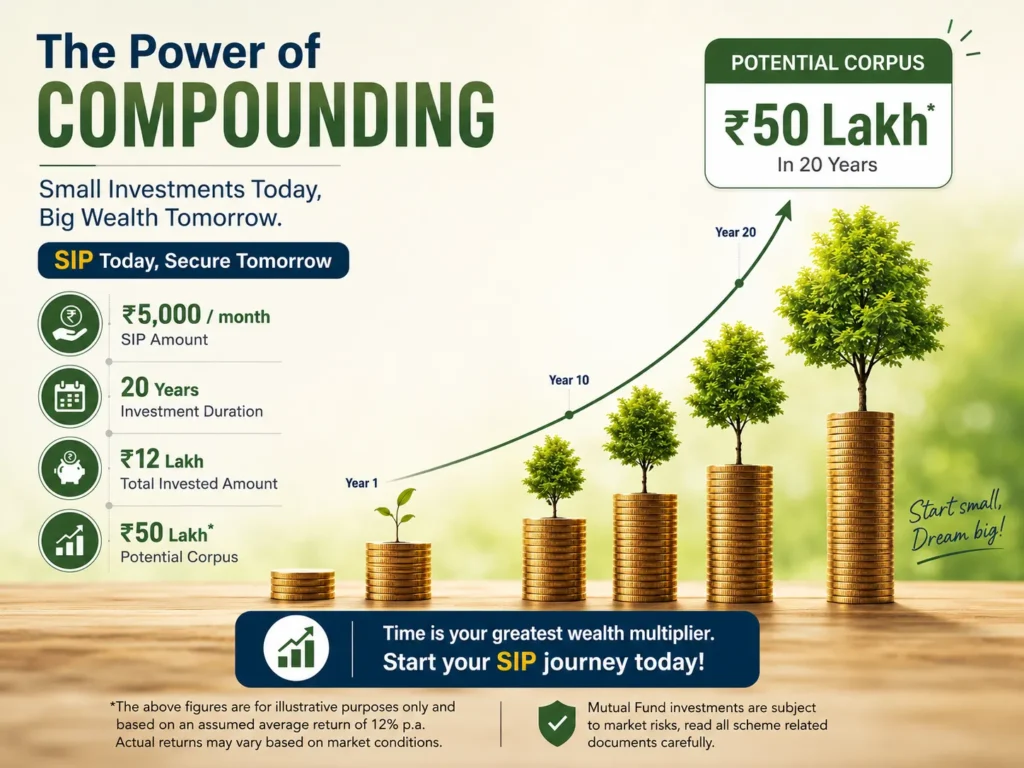
For example, if you invest ₹5,000 per month through a SIP and earn an average annual return of 12%, your investment could potentially grow to more than ₹50 lakh in 20 years. Starting early can make a significant difference in the final amount accumulated.
Investment planning also helps individuals:
- Build long-term wealth
- Beat inflation
- Achieve financial goals
- Create retirement security
- Maintain financial discipline
- Prepare for emergencies
- Generate additional income over time\
Another important benefit of investment planning is reducing financial stress. People who regularly invest and plan their finances are generally better prepared for unexpected expenses such as medical emergencies, job loss, or economic uncertainties.
In today’s fast-changing financial environment, having a well-planned investment strategy is no longer optional—it is essential. By choosing the right investment plans and staying invested for the long term, individuals can improve their financial stability and work toward achieving financial independence.
| Investment Type | Expected Return (2026) | Risk Level | Lock-in Period | Tax Benefit (80C) | Best For |
|---|---|---|---|---|---|
| SIP Mutual Funds | 10%-15%* | High | None | ELSS Only | Wealth Creation |
| ELSS Funds | 10%-15%* | High | 3 Years | Yes | Tax Saving + Growth |
| PPF | 7%-8% | Low | 15 Years | Yes | Long-Term Safety |
| NPS | 8%-12%* | Medium | Till Retirement | Yes | Retirement Planning |
| ULIP Investment Plans | 8%-12%* | Medium | 5 Years | Yes | Insurance + Investment |
| Fixed Deposits | 6%-8% | Low | 7 Days–10 Years | Limited | Capital Protection |
| Gold (ETF/SGB) | 7%-10%* | Medium | 5–8 Years | No | Diversification |
| Real Estate Investments | 8%-15%* | Medium-High | Long-Term | No | Property Appreciation & Rental Income |
| LIC Investment Plans | 5%-7% | Low | Policy Term | Yes | Insurance + Savings |
SIP Mutual Funds
SystemaSystematic Investment Plans (SIPs) are one of the easiest and most popular ways to invest in mutual funds. Instead of investing a large amount at once, SIPs allow you to invest a fixed amount every month.
Many people use SIPs to achieve important financial goals such as retirement planning, children’s education, buying a house, and long-term wealth creation. Regular investing helps build a good financial habit and allows your money to grow over time through compounding.
For example, if you invest ₹5,000 every month through a SIP for 20 years and earn an average annual return of 12%, your total investment of ₹12 lakh could potentially grow to around ₹50 lakh. This shows how regular investing and the power of compounding can help create substantial wealth over the long term.
Since SIPs invest in market-linked mutual funds, returns may go up or down in the short term. However, investing regularly and staying invested for the long term can help reduce the impact of market fluctuations.
Because of their flexibility, affordability, and potential for long-term growth, SIP Mutual Funds are considered one of the best investment plans in India.
ELSS Funds
Equity Linked Savings Scheme (ELSS) is a popular tax-saving mutual fund in India. ELSS funds invest mainly in the stock market and offer the dual benefit of wealth creation and tax savings.
One of the biggest advantages of ELSS funds is that investments up to ₹1.5 lakh per year may qualify for tax deductions under Section 80C of the Income Tax Act. ELSS also has the shortest lock-in period among tax-saving investments, which is just 3 years.
For example, if you invest ₹50,000 in an ELSS fund, you may be able to reduce your taxable income while also giving your money an opportunity to grow through stock market investments.
Since ELSS funds are linked to the stock market, returns are not guaranteed and may fluctuate in the short term. However, many investors choose ELSS for long-term wealth creation and tax-saving benefits.
Because of their growth potential, tax advantages, and relatively short lock-in period, ELSS Funds are considered one of the best investment options in India for tax-conscious investors.
Public Provident Fund (PPF)
Public Provident Fund (PPF) is one of the safest and most trusted investment options in India. It is a government-backed savings scheme designed to help individuals build long-term wealth while enjoying tax benefits.
Many investors prefer PPF because it offers stable returns, government security, and tax-saving advantages. Since the scheme is backed by the Government of India, it is considered a low-risk investment option.
For example, if you regularly invest money in a PPF account every year, your savings can grow steadily over time while earning interest. This makes PPF a popular choice for retirement planning and long-term financial goals.
PPF comes with a 15-year lock-in period, which encourages disciplined saving and long-term investing. Due to its safety, tax benefits, and reliable returns, PPF is often considered one of the best investment plans in India for conservative investors. Best place to invest in PPF is Indian Post.
National Pension System (NPS)
National Pension System (NPS) is a government-supported retirement investment plan that helps individuals build a retirement fund over the long term. It is designed for people who want regular income and financial security after retirement.
NPS invests money across different asset classes, including equities, government securities, and corporate bonds. This combination helps balance growth potential and investment risk.
One of the biggest benefits of NPS is its tax-saving advantage. Investors can claim tax deductions under applicable income tax rules, making it a popular choice among salaried employees and self-employed individuals.
For example, if you invest regularly in NPS throughout your working years, you can accumulate a substantial retirement corpus that can help support your expenses after retirement.
Because of its retirement focus, tax benefits, and long-term growth potential, NPS is considered one of the best investment plans in India for retirement planning.Official: https://www.npscra.nsdl.co.in
ULIP Investment Plans
ULIP stands for Unit Linked Insurance Plan. ULIPs combine life insurance protection with market-linked investment opportunities.
A portion of the premium provides insurance coverage while the remaining amount is invested into market-linked funds.
ULIPs may help individuals:
- create long-term wealth
- save taxes
- gain insurance protection
- plan retirement
- build disciplined investments
Since ULIPs are market-linked products, returns depend on financial market performance. Investors should carefully understand policy charges and risks before investing.
ULIPs are commonly preferred by investors looking for insurance and investment benefits under one financial product.
Fixed Deposits
FixFixed Deposits (FDs) are one of the most popular and safest investment options in India. In a fixed deposit, you invest a lump sum amount with a bank or financial institution for a fixed period and earn a predetermined rate of interest.
Many investors choose FDs because they offer stable returns, capital protection, and low investment risk. Unlike market-linked investments, FD returns are not affected by stock market fluctuations, making them suitable for conservative investors.
For example, if you invest ₹1 lakh in a fixed deposit for 5 years at an interest rate of 7% per year, your investment could grow to approximately ₹1.40 lakh at maturity. This means you may earn around ₹40,000 in interest while keeping your capital relatively safe.
Fixed Deposits are commonly used for emergency funds, short-to-medium-term financial goals, and preserving capital. Due to their safety, predictable returns, and ease of investment, FDs remain one of the best investment options in India for low-risk investors.
LIC Investment Plans
LIC Investment Plans are popular among investors who want both life insurance protection and long-term savings. These plans help individuals build a financial corpus while providing security for their families.
Many people choose LIC plans because they offer insurance coverage, disciplined savings, maturity benefits, and potential bonus additions in eligible policies. They are especially suitable for conservative investors looking for stable and low-risk investment options.
For example, if you invest ₹5,000 per month in a LIC savings plan for 20 years, you can build a substantial maturity amount while also enjoying life insurance coverage during the policy term.
Popular LIC investment plans include endowment plans, pension plans, child education plans, and long-term savings plans. These plans are often used for retirement planning, children’s future expenses, and long-term financial security.
Because of their combination of protection and savings benefits, LIC Investment Plans remain one of the preferred investment options in India for long-term financial planning.
Gold Investments
Gold has been a popular investment choice in India for generations. Many investors buy gold to protect their wealth during inflation, economic uncertainty, and market volatility.
Today, investors can invest in gold through physical gold, Gold ETFs, Sovereign Gold Bonds (SGBs), and digital gold. These options provide different ways to gain exposure to gold without necessarily purchasing jewelry or coins.
For example, if you invest ₹50,000 in gold and gold prices increase over time, the value of your investment may also rise. However, gold prices can fluctuate based on market demand, global economic conditions, and geopolitical events.
Gold is often used as a diversification tool because its performance may differ from stocks and other investments. For this reason, many financial experts recommend keeping a small portion of a portfolio in gold as part of a balanced investment strategy.
Due to its historical value and ability to act as a hedge against inflation, Gold Investments remain an important component of long-term financial planning.
Real Estate Investments
Real Estate is one of the most popular long-term investment options in India. Investing in property can help individuals build wealth while providing the benefits of asset ownership and potential rental income.
Many investors choose real estate because property values may increase over time, especially in growing cities and developing areas. In addition, rental properties can generate a regular source of income.
For example, if you purchase a property for ₹30 lakh and its value increases to ₹45 lakh over the next 10 years, you could earn significant returns through capital appreciation. If the property is rented out, you may also receive monthly rental income.
However, real estate investments usually require a large initial investment and may not be as easy to sell quickly as stocks or mutual funds. Factors such as location, infrastructure development, market conditions, and property quality play a major role in determining returns.
Because of its potential for long-term appreciation and income generation, Real Estate remains an important investment option for individuals seeking long-term financial growth and asset creation.
How to Choose the Right Investment Plan
Choosing the best investment plan in India is not about selecting the option with the highest returns. The right investment depends on your financial goals, risk tolerance, and how long you plan to stay invested.
Before investing, ask yourself a few simple questions. Are you investing for retirement, your child’s education, buying a house, or simply growing your wealth? Your financial goal will help determine which investment option is most suitable for you.
You should also consider factors such as:
- Investment duration
- Financial goals
- Risk appetite
- Liquidity requirements
- Tax-saving needs
- Retirement planning objectives
For example, if you are comfortable taking some risk and want higher long-term returns, SIP Mutual Funds or ELSS Funds may be suitable options. On the other hand, if your priority is safety and stable returns, PPF, Fixed Deposits, or LIC Investment Plans may be a better choice.
It is also important not to put all your money into a single investment. Diversifying across different investment options such as SIPs, PPF, NPS, Gold, and Fixed Deposits can help reduce risk and create a more balanced portfolio.
The best investment plan is one that matches your financial goals, investment horizon, and comfort level with risk. A well-planned investment strategy can help you build wealth, achieve financial security, and meet your future financial needs with confidence.
Common Investment Mistakes
Investing is one of the best ways to build wealth, but many people make mistakes that can affect their financial goals. Understanding these common investment mistakes can help investors make better decisions and improve long-term returns.
One of the biggest mistakes is delaying investments. Many people wait for the “perfect time” to start investing, but starting early allows your money to benefit from the power of compounding. Even small investments can grow significantly over time when given enough years to compound.
Another common mistake is investing without a clear financial goal. Before investing, it is important to know whether you are saving for retirement, a child’s education, buying a home, or wealth creation. Clear goals help you choose the right investment products and investment period.
Many investors also panic when markets fall and stop investing or sell their investments. Market fluctuations are normal, especially in equity-based investments. Staying disciplined and focused on long-term goals is often more beneficial than reacting to short-term market movements.
Ignoring diversification is another mistake that can increase risk. Investing all your money in a single asset or investment product can be risky. A diversified portfolio that includes different investment options such as SIPs, PPF, NPS, Gold, and Fixed Deposits can help reduce overall risk.
Avoiding these common mistakes can help investors build a stronger portfolio and improve their chances of achieving long-term financial success.
Also Read
- Best Term Insurance Plans in India 2026
- Bajaj Allianz Life Insurance Company Limited Policy Details: Plans, Benefits, Claim Ratio & Features (2026)
- Upcoming Dividend Stocks This Week: TCS, Bajaj Auto, GSK Pharma, Tata Consumer & More — Ex-Dates, Payouts & Full Analysis (May 25–29, 2026)
- Top 5 Mutual Funds for SIP to Invest in 2026: Proven Picks for Outstanding Long-Term Wealth
Frequently Asked Questions(FAQ)
Q.1. What are the Best Investment Plans in India 2026?
Ans:- The Best Investment Plans in India 2026 include SIP Mutual Funds, ELSS Funds, PPF, NPS, Fixed Deposits, Gold, ULIPs, and LIC Investment Plans.
Q.2. Which are the safest Best Investment Plans in India 2026?
Ans:- PPF, Fixed Deposits, and LIC Investment Plans are among the safest Best Investment Plans in India 2026 for conservative investors.
Q.3. Which Best Investment Plans in India 2026 offer tax benefits?
Ans:- ELSS Funds, PPF, NPS, ULIPs, and certain LIC plans offer tax-saving benefits under applicable income tax rules.
Q.4. Which Best Investment Plans in India 2026 are suitable for long-term wealth creation?
Ans:- SIP Mutual Funds, ELSS Funds, and NPS are among the Best Investment Plans in India 2026 for long-term wealth creation and retirement planning.
Q.5. Is SIP one of the Best Investment Plans in India 2026?
Ans:- Yes, SIP Mutual Funds are considered one of the Best Investment Plans in India 2026 due to their flexibility, affordability, and long-term growth potential.
Q.6. How do I choose the Best Investment Plans in India 2026?
Ans:- Choose an investment plan based on your financial goals, risk appetite, investment horizon, and tax-saving requirements.
Final Thoughts
Best Investment Plans in India can help individuals create long-term financial security, manage inflation, and achieve important financial goals. Every investment product has different advantages, risks, and return expectations.
Before investing, individuals should carefully understand financial objectives, investment risks, and long-term suitability. Diversified investing combined with disciplined financial planning can help create stronger financial stability and long-term wealth growth.
Disclaimer
This article is for informational and educational purposes only and should not be considered financial or investment advice. Please consult a certified financial advisor before making investment decisions.