
Table of Contents
Best Mutual Funds in India 2026 for SIP — Overview
Best Mutual Funds in India 2026 for SIP this is one of the most searched investment questions right now, and for good reason.
India’s mutual fund industry crossed ₹65 lakh crore in total assets under management in 2026. SIP (Systematic Investment Plan) inflows have been consistently above ₹25,000 crore every single month. More Indians are investing through SIPs than ever before.
But with over 2,000 mutual fund schemes to choose from, picking the right 5 funds for your SIP portfolio is genuinely hard. One wrong choice can cost you lakhs in lost returns over a 10-year horizon.
This article cuts through the noise. We have screened mutual funds based on consistent long-term performance, fund manager track record, AUM size, expense ratio, and risk-adjusted returns — to give you the definitive list of the Best Mutual Funds in India 2026 for SIP.
Whether you are a first-time investor starting with ₹500/month or a seasoned investor reviewing your portfolio, this guide covers everything you need.
What Is a SIP and Why Is 2026 a Great Time to Start?
Before diving into the Best Mutual Funds in India 2026 for SIP, let us quickly establish why SIP is the most powerful wealth-building tool available to Indian retail investors.
SIP (Systematic Investment Plan) is a method of investing a fixed amount in a mutual fund at regular intervals — weekly, monthly, or quarterly. Instead of trying to time the market, SIP allows you to invest through all market cycles — highs and lows — and benefit from rupee cost averaging.
Why 2026 is a Particularly Good Year to Start:
- India’s GDP growth is projected at 6.5-7% for FY27, among the strongest in the world
- Corporate earnings growth for Nifty 50 companies is running at 12-15% YoY
- The RBI has room to cut interest rates further, which is positive for equity valuations
- India’s per capita income is rising, driving consumption across sectors
- Domestic institutional investors (DIIs) and retail SIP inflows are creating structural buying support
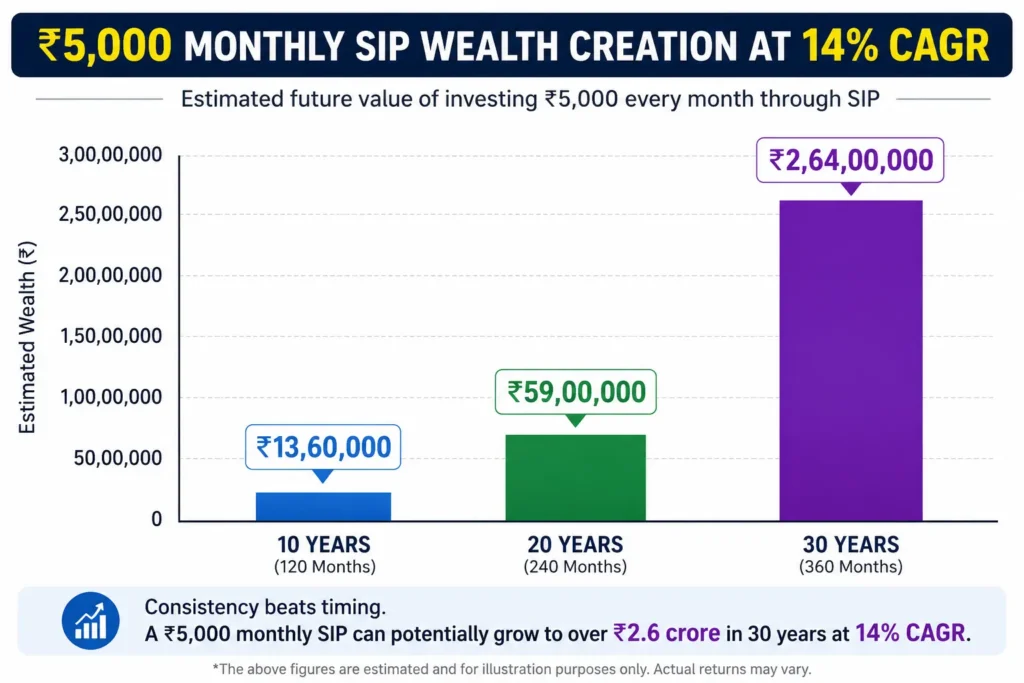
The longer you stay invested through SIP, the more powerful compounding becomes. A ₹5,000 monthly SIP at 14% CAGR for 30 years creates a corpus of over ₹1.6 crore. That same ₹5,000 SIP started 10 years later creates only ₹35 lakh.
Start now. Time in the market beats timing the market.
How We Selected These Best Mutual Funds in India 2026 for SIP
Our selection of the Best Mutual Funds in India 2026 for SIP is based on six strict criteria:
1. Consistent Performance: We looked at 3-year, 5-year, and 10-year returns — not just recent 1-year winners. Single-year outperformers often revert. Consistency is what matters for SIP investors.
2. AUM Above ₹10,000 Crore: Funds with very small AUM face liquidity risks during redemptions. We only considered well-established funds with deep investor trust.
3. Expense Ratio: Lower expense ratios directly translate into higher net returns for investors. We favoured Direct Plans (which have significantly lower expense ratios than Regular Plans).
4. Fund Manager Track Record: A good fund without a capable fund manager is a risk. We verified that each shortlisted fund has experienced, proven fund managers at the helm.
5. Risk-Adjusted Returns: Returns should be evaluated alongside risk. A fund that gives 20% returns but with extreme volatility may not be suitable for most SIP investors. We checked Sharpe ratios and drawdown history.
6. Category Coverage: Your SIP portfolio should not be concentrated in one category. Our top 5 covers flexi cap, mid cap, large cap, small cap, and index — giving you complete market exposure.
Parag Parikh Flexi Cap Fund Direct Growth
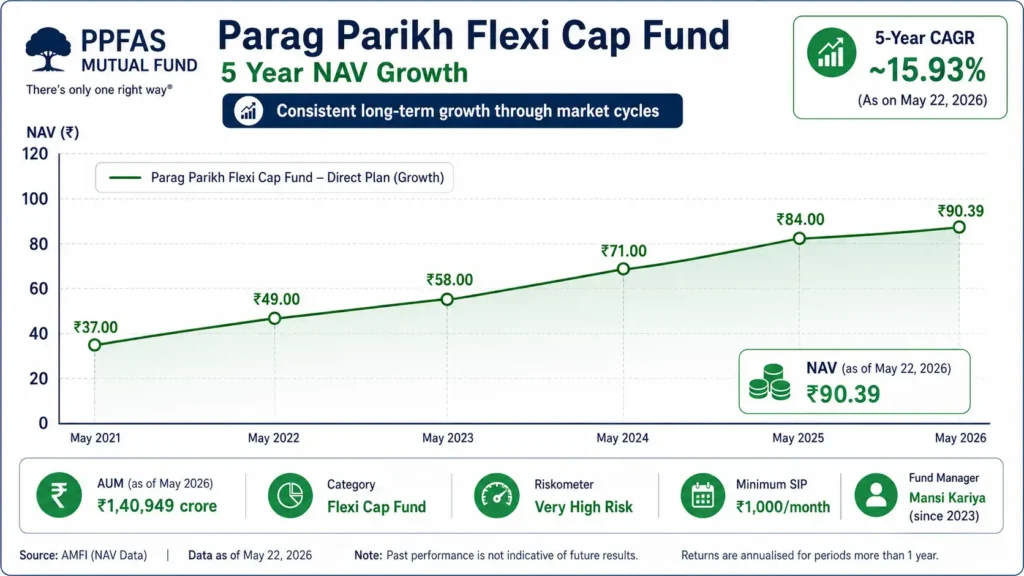
Category: Flexi Cap | Risk: Very High | Minimum SIP: ₹1,000/month
Parag Parikh Flexi Cap Fund is widely regarded as one of the best-managed mutual funds in India — and it sits at the very top of our top 5 mutual funds for SIP to invest in 2026 list.
Why Parag Parikh Flexi Cap Fund?
This fund does something most Indian mutual funds don’t — it invests not just in Indian stocks but also in carefully selected global equities (primarily US-listed companies like Alphabet, Meta, and Microsoft). This gives investors genuine international diversification within a single fund.
The fund follows a value investing philosophy, focusing on high-quality companies with strong competitive moats, bought at reasonable prices. This disciplined approach has helped the fund deliver consistently across multiple market cycles.
Key Data (as of May 2026)
| Metric | Details |
|---|---|
| AUM | ₹1,40,949 crore |
| NAV | ₹90.39 (as of May 22, 2026) |
| 3-Year SIP Returns | ~17-19% annualised |
| 5-Year CAGR | ~15.93% |
| Expense Ratio (Direct) | 0.53% |
| Minimum SIP | ₹1,000/month |
| Fund Manager | Mansi Kariya (since 2023) |
| Benchmark | BSE 500 TRI |
Who Should Invest?
Parag Parikh Flexi Cap Fund is ideal for investors with a minimum 7-year horizon who want a one-fund solution covering large, mid, small cap, and international equities in a single well-managed portfolio.
One Important Note: The fund’s PE ratio stands at 16.75 versus the category average of 26.08 — meaning it is significantly cheaper than its peers. This value orientation may lead to short periods of underperformance in bull markets, but tends to protect capital better during corrections.
HDFC Mid Cap Opportunities Fund Direct Growth
Category: Mid Cap | Risk: Very High | Minimum SIP: ₹100/month
HDFC Mid Cap Opportunities Fund is one of the most loved mid cap funds in India, and a cornerstone of thousands of long-term SIP portfolios. It makes our top 5 mutual funds for SIP to invest in 2026 list for its outstanding consistency over a full decade.
Why HDFC Mid Cap Opportunities Fund?
Mid cap stocks — companies ranked 101 to 250 by market capitalisation — are the sweet spot of Indian investing. They are large enough to be institutionally well-covered and financially stable, but small enough to still have enormous room to grow.
HDFC Mid Cap Opportunities Fund captures this opportunity brilliantly. The fund has an established track record of delivering significantly higher returns than the Nifty Midcap 150 index over rolling 5-year periods.
Key Data (as of May 2026)
| Metric | Details |
|---|---|
| AUM | ~₹75,000 crore+ |
| 3-Year SIP Returns | ~23% annualised |
| 5-Year CAGR | ~21% |
| Expense Ratio (Direct) | ~0.75% |
| Minimum SIP | ₹100/month |
| Category | Mid Cap Equity |
Who Should Invest?
This fund is best for investors who can stay invested for at least 5-7 years and are comfortable with higher short-term volatility in exchange for significantly higher long-term returns. Mid cap funds can fall 30-40% during market corrections — SIP investors who stay the course during these periods are the ones who benefit most.
If you want your SIP to work significantly harder than a large cap or index fund, HDFC Mid Cap is among the most proven options in India.
Mirae Asset Large Cap Fund Direct Growth
Category: Large Cap | Risk: Moderately High | Minimum SIP: ₹1,000/month
For investors who want stability alongside growth, Mirae Asset Large Cap Fund is our top 5 mutual funds for SIP to invest in 2026 pick in the large cap category.
Why Mirae Asset Large Cap Fund?
Large cap funds invest primarily in India’s top 100 companies by market capitalisation — the most financially stable, well-governed, and deeply liquid businesses in the country. This is the lowest-risk equity fund category.
Mirae Asset Large Cap Fund has a remarkable track record of beating the Nifty 100 index over a 10-year horizon — a rare achievement in the large cap space where most active funds struggle to outperform their benchmark. It has a massive AUM which speaks to investor trust.
Key Data (as of May 2026)
| Metric | Details |
|---|---|
| 5-Year CAGR | ~15.8% |
| 10-Year CAGR | ~14%+ |
| Risk Profile | Moderately High |
| Expense Ratio (Direct) | Low (under 0.6%) |
| Minimum SIP | ₹1,000/month |
| Best For | Conservative equity investors |
Who Should Invest?
Mirae Asset Large Cap Fund is ideal for conservative equity investors — those who want stock market exposure and inflation-beating returns but cannot stomach the wild swings of mid or small cap funds. It is also a good foundation for first-time SIP investors before they add mid or small cap exposure over time.
SBI Small Cap Fund Direct Growth
Category: Small Cap | Risk: Very High | Minimum SIP: ₹500/month
No list of the top 5 mutual funds for SIP to invest in 2026 is complete without a high-quality small cap fund. SBI Small Cap Fund is India’s most trusted name in this high-risk, high-reward category.
Why SBI Small Cap Fund?
Small cap funds invest in companies ranked below 250 by market capitalisation. These are India’s fastest-growing companies — emerging businesses in manufacturing, technology, chemicals, healthcare, and consumer goods that could become the large caps of tomorrow.
SBI Small Cap Fund has consistently delivered among the highest long-term returns of any mutual fund category in India. The fund is managed with a focus on finding quality small cap businesses before they become mainstream investment ideas.
Key Data (as of May 2026)
| Metric | Details |
|---|---|
| Fund House | SBI Mutual Fund |
| Category | Small Cap Equity |
| 5-Year CAGR | ~17%+ |
| Risk Profile | Very High |
| Minimum SIP | ₹500/month |
| Best For | Aggressive long-term investors |
Who Should Invest?
SBI Small Cap Fund is suited only for aggressive investors with a minimum 7-10 year investment horizon. Small cap funds can fall 50-60% during severe market corrections. However, for those who stay invested through these corrections via SIP, the long-term rewards are exceptional.
Limit your small cap exposure to 10-15% of your total SIP portfolio to manage risk effectively.
UTI Nifty 50 Index Fund Direct Growth
Category: Index Fund | Risk: Moderately High | Minimum SIP: ₹500/month
Our fifth pick in the top 5 mutual funds for SIP to invest in 2026 is the only passive fund on the list — UTI Nifty 50 Index Fund. And it belongs here for very good reason.
Why UTI Nifty 50 Index Fund?
Index funds simply replicate the Nifty 50 — India’s 50 largest companies by market capitalisation. There is no active stock picking, no fund manager risk, and the expense ratio is extremely low (under 0.20%).
Global research consistently shows that over a 15-20 year horizon, the majority of active funds fail to outperform their benchmark index. An index fund guarantees you will match the Nifty 50 return — which has historically delivered around 12-13% CAGR over 20-year periods.
Key Data (as of May 2026)
| Metric | Details |
|---|---|
| Fund House | UTI Mutual Fund |
| Category | Large Cap Index |
| Tracks | Nifty 50 TRI |
| Expense Ratio (Direct) | ~0.18% (extremely low) |
| Minimum SIP | ₹500/month |
| Risk Profile | Moderately High |
Who Should Invest?
UTI Nifty 50 Index Fund is perfect for every type of investor. Beginners love it because it is simple and low-cost. Experienced investors use it as a stable core holding. Even if you invest in all 4 other funds on this list, having 20-30% of your SIP in a Nifty 50 index fund provides a reliable anchor.
Best Mutual Funds India 2026 — Side by Side Comparison
| Fund Name | Category | 5-Yr CAGR | Min SIP | Risk | Best For |
|---|---|---|---|---|---|
| Parag Parikh Flexi Cap | Flexi Cap | ~15.9% | ₹1,000 | Very High | All-in-one SIP investors |
| HDFC Mid Cap Opp. | Mid Cap | ~21% | ₹100 | Very High | Growth-focused investors |
| Mirae Asset Large Cap | Large Cap | ~15.8% | ₹1,000 | Mod. High | Conservative equity investors |
| SBI Small Cap | Small Cap | ~17%+ | ₹500 | Very High | Aggressive long-term investors |
| UTI Nifty 50 Index | Index | ~12-13% | ₹500 | Mod. High | Every type of investor |
A smart portfolio for most investors would be: 40% Parag Parikh Flexi Cap + 25% HDFC Mid Cap + 20% UTI Nifty 50 Index + 10% SBI Small Cap + 5% Mirae Asset Large Cap. Adjust these weightings based on your risk appetite and investment horizon.
How Much SIP Should You Start With in 2026?
The most common question after identifying the top 5 mutual funds for SIP to invest in 2026 is: how much should I invest per month?
The answer depends entirely on your financial goal. Here is a simple framework:
Goal: ₹1 Crore in 15 years at 14% CAGR → Required monthly SIP: approximately ₹15,000
Goal: ₹50 lakh in 10 years at 14% CAGR → Required monthly SIP: approximately ₹16,000
Goal: ₹25 lakh in 7 years at 14% CAGR → Required monthly SIP: approximately ₹17,500
You can use the free SIP Calculator on NSE India to compute exactly what corpus your monthly SIP will create based on your expected return rate and tenure.
Even if you can only start with ₹500 per month today, start immediately. Increase your SIP amount by 10% every year as your income grows. This step-up SIP approach dramatically accelerates your wealth creation.
For detailed guidance on how SIP compounding works and how to track your SIP performance, read AMFI India’s official investor education resources at amfiindia.com — India’s mutual fund industry regulator.
Common Mistakes to Avoid When Investing in SIP in 2026
Even with the top 5 mutual funds for SIP to invest in 2026 in your portfolio, these common mistakes can destroy your returns:
Mistake 1 — Stopping SIP During Market Falls The biggest mistake retail investors make. Market corrections are the best time to be running SIP because you are buying more units at lower prices. Stopping SIP during a crash locks in your losses and destroys rupee cost averaging.
Mistake 2 — Investing in Too Many Funds Investing in 8-10 mutual funds does not reduce risk — it creates an expensive, overlapping mess. Five well-chosen funds from different categories are more than enough.
Mistake 3 — Choosing Regular Plans Over Direct Plans Regular Plans pay a commission to distributors from your returns. Over 20 years, this cost difference can amount to lakhs of rupees. Always choose Direct Plans when investing through platforms like Groww, Zerodha Coin, or MF Central.
Mistake 4 — Ignoring Expense Ratio A 1% difference in expense ratio across 20 years of compounding can mean the difference of ₹20-30 lakh in your final corpus. Always check and compare expense ratios before selecting a fund.
Mistake 5 — Chasing Last Year’s Top Performer The fund that topped the returns chart last year is often not the best pick for next year. Focus on 3-5 year consistency, not 1-year rankings.
Mistake 6 — Not Reviewing Your Portfolio Annually SIP is not fully hands-off. Review your portfolio once a year. If a fund has consistently underperformed its benchmark and peers for 3+ years, consider switching.
Also Read
- Market Gap Up Tomorrow May 25: 7 Powerful Reasons Nifty Is Ready to Surge
- Teamtech Formwork Solutions IPO Allotment Status 2026 — Check Now
FAQ
Q1. Which is the best mutual fund for SIP in 2026?
Ans:- Parag Parikh Flexi Cap Fund is widely considered the most well-rounded option for SIP in 2026 — offering diversification across large, mid, small cap, and international equities with a proven value investing philosophy and a 5-year CAGR of ~15.9%.
Q2. Which mutual fund gives the highest return in SIP in 2026?
Ans:- Mid cap and small cap funds typically deliver the highest returns over long SIP tenures. HDFC Mid Cap Opportunities Fund has delivered approximately 21-23% annualised SIP returns over 3-5 years, making it one of the highest-returning funds in our top 5 list.
Q3. Is 2026 a good time to start SIP in mutual funds?
Ans:- Yes. India’s economic growth remains strong, corporate earnings are healthy, and the RBI has room for further rate cuts. Long-term SIP investors who start in 2026 are well-positioned to benefit from India’s multi-decade growth story.
Q4. How much should I invest in SIP per month in 2026?
Ans:- Even ₹500-₹1,000 per month is a meaningful start. Use a SIP calculator to map your specific target corpus and work backwards to your required monthly SIP amount. Increase your SIP by 10% each year as your income grows.
Q5. Should I invest in Direct or Regular mutual fund plans?
Ans:- Always choose Direct Plans. They have lower expense ratios (typically 0.5-1% lower) than Regular Plans. Over a 20-year SIP, this can result in several lakhs of rupees in additional returns.
Q6. Is UTI Nifty 50 Index Fund better than active large cap funds?
Ans:- For most investors, yes. Over 15+ year periods, most active large cap funds fail to consistently beat the Nifty 50 index after expense ratios. UTI Nifty 50 Index Fund guarantees you the market return at a minimal cost of ~0.18% expense ratio.
Q7. Can I invest in all 5 funds simultaneously?
Ans:- Yes, and it is actually a smart strategy. Spreading your monthly SIP across these 5 funds gives you exposure to large cap, mid cap, small cap, flexi cap, and index categories — creating a diversified, balanced equity portfolio.
Q8. What is the ideal SIP investment horizon for these top 5 funds?
Ans:- A minimum of 5 years for large cap and index funds, and at least 7-10 years for mid cap and small cap funds. The longer you stay invested, the more powerful compounding becomes and the lower your risk of negative returns.
Disclaimer: This article is for educational and informational purposes only. Mutual fund investments are subject to market risks. Past performance is not indicative of future returns. The funds mentioned are for informational purposes and do not constitute investment recommendations. Please consult a SEBI-registered investment advisor or AMFI-registered mutual fund distributor before making any investment decisions. Read all scheme-related documents carefully before investing.