
Table of Contents
Market Gap Up Tomorrow May 25 — What’s Happening?
Market gap up tomorrow May 25 is looking highly likely — and the signals are unusually strong this weekend.
There are not one, not two, but multiple converging factors pointing toward a sharp gap up opening for Indian markets on Monday, May 25, 2026. The most powerful of these is a massive crash in crude oil prices in weekend futures, combined with significantly higher Dow Jones weekend futures.
If you missed Friday’s live session or are trying to understand what’s going on before Monday’s opening bell, this is the complete breakdown you need.
Let’s go through every factor, every key Nifty level, and the stocks to watch — so you walk into Monday’s market session completely prepared.
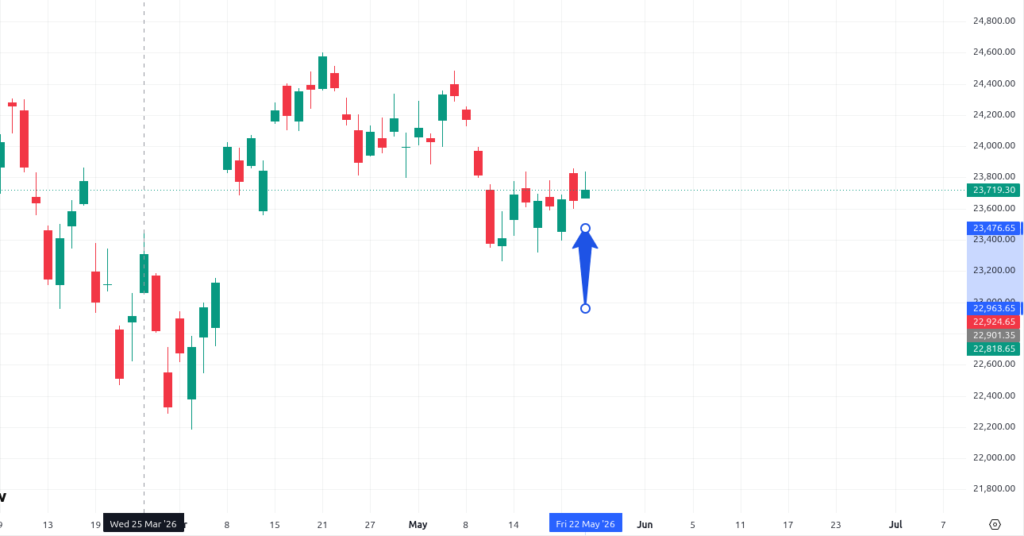
Reason 1: Crude Oil Crashes 6.3% in Weekend Futures
The single biggest driver of the market gap up tomorrow May 25 story is crude oil.
Crude oil has crashed approximately 6.32% in weekend futures as of Saturday evening. This is not a small move. A 6-7% single-weekend crash in crude oil is a rare and significant event that has broad implications for the Indian economy and stock market.
Why Does Crude Crash Matter for Indian Markets?
India imports over 85% of its crude oil requirement. When crude prices fall sharply, the benefits flow through the entire economy:
- Inflation comes down — lower fuel costs reduce transportation and production costs across all sectors
- Current Account Deficit narrows — India spends less foreign exchange on oil imports
- RBI gets more room — lower inflation gives the Reserve Bank of India more space to cut interest rates
- Fuel subsidy burden on government reduces — which is positive for fiscal deficit
- Corporate margins improve — especially for airlines, paint companies, logistics, chemicals, and FMCG
All of these factors are immediately positive for Indian equities. A 6.3% crude crash over a single weekend is more than enough reason for a sharp gap up on Monday morning.
Is This a Sustained Crash or a One-Day Move?
The important question for traders is whether this crude crash will hold through Monday. Weekend futures are thinner in volume than regular trading hours, so some reversal is possible. However, given that this is a multi-factor move (not just a one-off news spike), the directional impact on Indian markets is likely to be sustained.
Reason 2: Dow Jones Weekend Futures Are Significantly Higher
The second major signal supporting the market gap up tomorrow May 25 thesis is the Dow Jones weekend futures, which are trading meaningfully higher.
When US markets close on Friday and weekend futures extend trading, a strongly positive weekend futures reading typically indicates that global sentiment has shifted positively. Indian markets tend to open in line with this global mood, especially when domestic triggers are absent.
Combined with the crude crash, the Dow Jones weekend futures signal creates a double confirmation for a gap up opening on Monday.
How Much Gap Up Are We Looking At?
Based on the current weekend signals — a 6.3% crude crash and strong Dow futures — the Nifty could gap up in the range of 150 to 300 points at Monday’s open. The exact level will depend on overnight developments, but the directional bias is clearly upward unless something unexpected happens before Monday’s open.
Reason 3: Ceasefire News Boosts Global Sentiment
The third factor driving the market gap up tomorrow May 25 expectation is ongoing ceasefire news.
While ceasefire discussions have been in the news for some time, the weekend brought fresh momentum to these developments. Geopolitical de-escalation — or even the expectation of it — tends to reduce the risk premium in global markets.
Important Caveat: Ceasefire news has been circulating for weeks and is not new in itself. The more impactful, more reliable signals remain the crude crash and the Dow futures. The ceasefire news is a supporting factor but should not be the primary basis for any trading decision on Monday.
The key rule: rely on price action and hard data (crude futures, index futures) over news headlines when forming a market view.
Nifty Key Levels for Monday May 25 — Resistance & Support
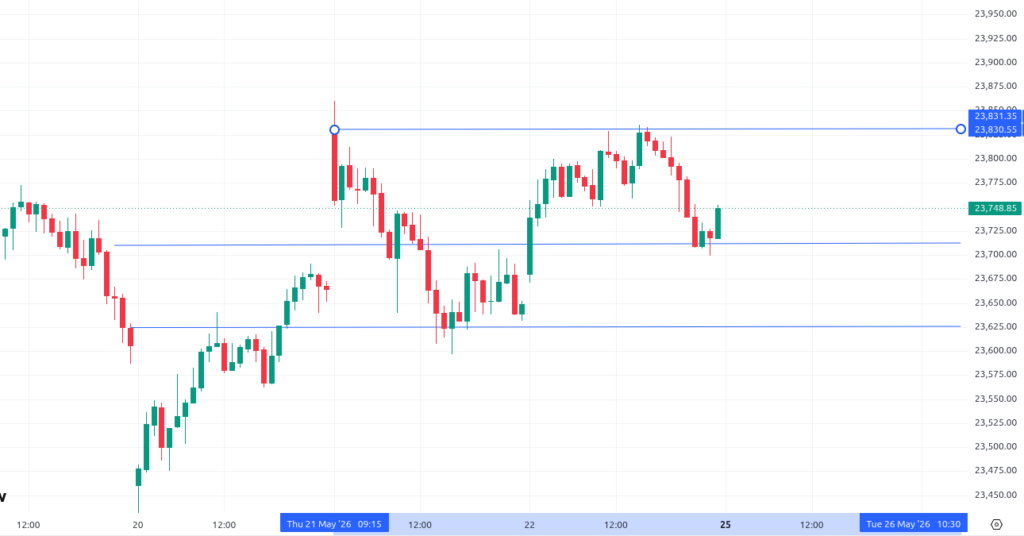
For the market gap up tomorrow May 25, here are the precise Nifty levels to mark on your chart before Monday’s opening bell:
Key Resistance Levels
| Level | Significance |
|---|---|
| 860 (Bank Nifty / key index level) | First critical resistance. Most important level of the day. |
| 905 | Second resistance — if 860 is cleared |
| 24,000 | Psychological resistance on Nifty |
| 24,085 | Next target after 24,000 breakout |
| 24,250 | Extended target |
| 24,350 | Further upside if momentum continues |
Key Support Levels
| Level | Significance |
|---|---|
| 671 | Strong support — buyers expected here |
How to Use These Levels
860 is the most important level of the day. If the market opens with a gap up but struggles to sustain above 860, it could indicate that bulls are taking profits at this resistance. Watch for price action at 860 carefully before adding long positions.
If Nifty opens and quickly moves above 24,000, the next targets of 24,085, 24,250, and 24,350 come into play. These are levels where you should be booking partial profits if you are in long trades from before the open.
671 is your safety net. If something goes wrong after the gap up and the market reverses, 671 is the support level where buyers are expected to step in.
Semiconductor Stocks — Big Opportunity on Monday?
One of the most exciting sub-stories within the market gap up tomorrow May 25 setup is the semiconductor sector.
There is significant news flow around semiconductor stocks this weekend — both globally and in the Indian context. This creates a very specific opportunity:
The Semiconductor Trade Setup for Monday:
- If semiconductor-related stocks open flat or gap down despite overall market strength → This is a strong buying opportunity. The sector has strong tailwinds and any weakness on open can be used to accumulate
- If semiconductor stocks gap up significantly → Be more cautious. High gaps in a sector with strong news can sometimes lead to “buy the rumour, sell the news” action
Key Principle: In a strong gap up market like we are expecting tomorrow, stocks with sector-specific positive news that open flat or lower are often the best trades of the day. The broader market’s strength eventually pulls them up, offering leveraged gains.
Keep semiconductor stocks on your watchlist and have your entry levels ready before Monday’s open.
Friday’s Market Action Explained — The Trap Was Set
To fully understand why the market gap up tomorrow May 25 matters, it helps to understand what happened on Friday, May 23.
Friday’s session saw a sharp and deliberate move: the market initially moved higher, then showed a strong selling move that scared retail traders. This had two effects:
- Bulls (long holders) panicked and cut their positions — reducing the “long overhang” in the market
- Bears became fully convinced of a gap down opening on Monday — increasing short positions
This is a classic market trap. By the end of Friday, most retail participants were expecting a gap down on Monday. This bearish positioning actually sets up the perfect conditions for a sharp gap up — because when the market opens higher, all those bears (short sellers) will be forced to cover their positions, adding more buying pressure.
The Daily Chart Signal:
Despite the scary Friday selloff, the Nifty daily chart shows an inverted helicopter candle pattern — a bullish reversal signal that suggests the selling on Friday was indeed a trap and not a genuine trend change.
This pattern, combined with crude crash and strong global futures, makes the case for a market gap up tomorrow May 25 even more compelling.
Crude Oil MCX Levels — Where Will It Open Monday?
For commodity traders watching the market gap up tomorrow May 25 setup, here are the key MCX crude oil levels:
| MCX Crude Level | Significance |
|---|---|
| ₹8,580 | First support — watch this level at Monday’s open |
| ₹8,210 | Major support — key floor level for MCX crude |
MCX crude is expected to gap down significantly on Monday, in line with the 6.3% crash seen in international weekend futures.
If MCX crude opens near ₹8,580 or below, it confirms the bearish crude setup and provides further fuel for the equity market’s bullish gap up.
Trading MCX Crude on Monday:
Crude traders should be careful about chasing shorts at the open — a 6% weekend fall often leads to some short-covering bounce in the early minutes of trading. Wait for the initial volatility to settle, then assess whether crude is finding support at ₹8,580 or breaking below it toward ₹8,210.
For more on commodity trading and its impact on Indian equities, you can check the MCX official website for live commodity data on Monday.
Trading Strategy for Monday May 25 Gap Up Opening
A market gap up tomorrow May 25 requires a specific approach — different from a flat or gap down open. Here is a structured strategy:
Step 1 — Do Not Chase the Open
Never buy at the exact open of a gap up session. The first 5-10 minutes are the most volatile and often reverse. Wait for the gap to settle and see which direction the market wants to move.
Step 2 — Identify Your Reference Levels
Mark 860 (resistance) and 671 (support) on your chart before the open. These are your anchors for the day.
Step 3 — Wait for 860 to be Tested
If the market opens above 860 and holds → Trend is clearly up. Look for pullbacks to add longs. If the market opens below 860 and struggles → Wait for a clear breakout above 860 before going long.
Step 4 — Semiconductor Stocks Specific Plan
Prepare a watchlist of 3-5 semiconductor-linked stocks. Set your buy alerts for levels that are flat or below Friday’s close. If they trigger while the broader market is strong, these could be the best trades of the day.
Step 5 — Protect Profits Early
On a gap up day, markets sometimes give back gains in the second half of the session. Book partial profits at 24,085 and again at 24,250 if Nifty reaches those levels. Keep a trailing stop loss for the remaining position.
What to Watch After the Gap Up Opens
Once the market gap up tomorrow May 25 happens, these are the key things to monitor throughout the day:
Crude Oil MCX: Watch the first 15 minutes of MCX crude trading. If crude holds its losses and does not recover sharply, equity markets will maintain their strength throughout the day.
Global Markets: Keep an eye on SGX Nifty and US futures through the day. Any sudden reversal in global markets can quickly erase the gap up gains.
FII Activity: Check FII buy/sell data after 3:30 PM on NSE. Consistent FII buying on a gap up day is a strong confirmation that the move is sustainable.
Volume: A gap up on high volume is much more reliable than a gap up on thin volume. Check volume against Friday’s session to assess conviction.
Nifty Bank: Bank Nifty often leads Nifty. If Bank Nifty is holding above its key resistance levels and showing strength, Nifty is likely to follow.
For live market data, FII/DII activity, and real-time Nifty levels, bookmark the NSE official website and the BSE India website.
Also Read
- Merritronix IPO 2026: Complete Review, GMP, Price Band, Dates & Should You Apply?
- LIC Share Price Target 2026, 2027, 2028, 2029 & 2030 — Honest Analysis With Real Data
- NSE vs BSE: 7 Powerful Differences Every Indian Investor Must Know in 2026
- KPI Green Energy Share Price Target 2026 to 2030: Brilliant Growth Story Every Smart Investor Must Know
FAQ
Q1. Why is the market expected to gap up tomorrow on May 25?
Ans:- Three primary reasons: crude oil crashing 6.3% in weekend futures, Dow Jones weekend futures trading significantly higher, and positive global sentiment from ceasefire developments.
Q2. How much gap up is expected on May 25?
Ans:- Based on current signals, Nifty could gap up in the range of 150 to 300 points. The exact gap will depend on overnight developments before Monday’s open.
Q3. What is the most important Nifty level for Monday May 25?
Ans:- 860 is the most critical resistance level. Above 860, the next targets are 905, 24,000, 24,085, 24,250, and 24,350. Support is at 671.
Q4. Should I buy immediately when the market gaps up?
Ans:- No. Always wait for the first 5-10 minutes to pass before entering any trade. Gap up opens can reverse sharply in the early minutes. Watch for price confirmation at key levels.
Q5. What sectors should I watch on Monday May 25?
Ans:- Semiconductor stocks are the primary sector to watch. Stocks that open flat or slightly down in a gap up market often offer the best risk-reward setups. Also watch crude-sensitive sectors like aviation, paints, logistics, and chemicals — all of which benefit from lower crude prices.
Q6. Where will MCX crude open on Monday?
Ans:- MCX crude is expected to gap down significantly. Key levels are ₹8,580 (first support) and ₹8,210 (major support). Watch these levels at Monday’s MCX open.
Q7. What if something negative happens overnight and the gap up doesn’t happen?
Ans:- Market predictions are based on current data and can change. Always have a risk management plan in place. If Nifty opens flat or lower despite weekend signals, reassess before trading. Never over-leverage based on pre-market expectations.
Q8. What is the inverted helicopter pattern on the daily chart?
Ans:- The inverted helicopter (also called an inverted hammer or dragonfly doji variant in different contexts) is a bullish candlestick pattern seen on the daily chart after a downward move. It suggests that sellers attempted to push the market lower but buyers stepped in strongly, indicating a potential reversal or continuation of the uptrend.
Disclaimer: This article is for educational and informational purposes only and does not constitute investment or trading advice. Stock market trading involves significant risk. All levels and predictions mentioned are based on technical analysis and current data, which can change rapidly. Please consult a SEBI-registered investment advisor before making any trading or investment decisions. Past performance and technical signals are not guarantees of future results.