
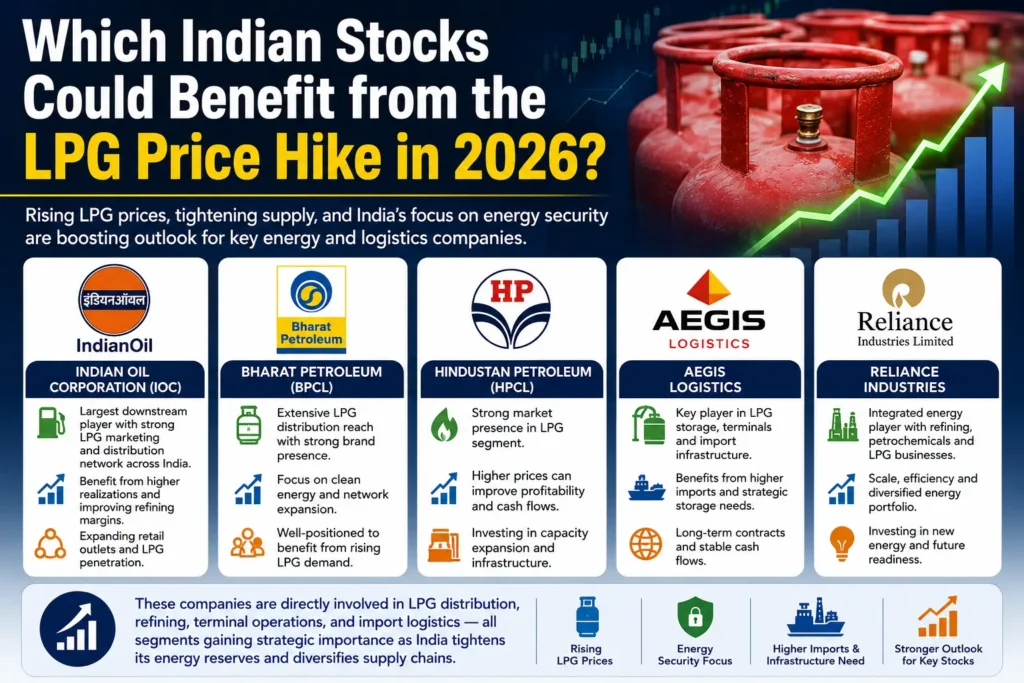
If you’ve recently noticed higher food delivery prices or a bigger bill at your favourite restaurant, there’s a direct reason the LPG price hike in June 2026. On June 1, India’s oil marketing companies (OMCs) raised the price of 19 kg commercial LPG cylinders by ₹42 to ₹53.50 across major cities, marking the fifth price increase in just four months. This LPG price hike June 2026 isn’t happening in a vacuum. It’s the result of a confluence of global and domestic forces and for equity investors, it’s also creating some interesting opportunities.
Table of Contents
Why Investors Are Paying Attention
The June 1 hike pushed the price of a 19 kg commercial cylinder to ₹3,113.50 in Delhi and ₹3,255.50 in Kolkata the steepest levels seen in years. This follows an extraordinary ₹993-per-cylinder surge that happened as recently as May 1, triggered by disruptions to global LPG supplies linked to the ongoing Middle East conflict. Cumulatively, commercial LPG prices have risen more than ₹1,400 in several regions since January 2026 alone.
For investors tracking the LPG market in India, these price movements deserve serious attention.
What Is Driving LPG Prices Higher in 2026?
The Strait of Hormuz Factor
The single biggest driver of India’s LPG price hike in 2026 is geopolitical. The escalating US-Iran conflict has disrupted shipping lanes through the Strait of Hormuz a narrow waterway roughly 33 kilometres wide through which nearly 20% of the world’s oil and a massive share of global LPG flows.
India imports approximately 88% of its crude oil needs, and around 52% of those imports transit the Strait of Hormuz. For LPG specifically, the Gulf region supplies about 60% of India’s consumption. When that corridor faces disruption, prices spike almost immediately.
India’s LPG Import Dependency
India’s vulnerability to Hormuz disruption is structural, not incidental. The country’s crude oil basket is calculated as a weighted average of Dubai and Oman benchmarks the Middle Eastern grades that dominate Indian imports. When Middle East supply is squeezed, India’s crude basket feels the impact more acutely than the global Brent headline. During the peak of the 2026 tensions, India’s crude basket surged from around $63 to $146 per barrel, while Brent “only” moved from roughly $70 to $126.
S&P Global Commodities at Sea data confirms that India’s Hormuz exposure has actually increased in early 2026 rising from 41% in 2025 to 52% partly because Indian refiners pulled back from Russian crude purchases, averaging around 1.15 million barrels per day in the first two months of 2026 compared to 1.7 million in 2025.
Government’s Reserve-Building Push
In response to supply pressure, the Indian government has directed oil companies to hold a minimum of 30 days of LPG demand in reserve, with a stated goal of eventually reaching 30–60 days. India currently holds approximately 50 days of total energy supply buffer when combining its Strategic Petroleum Reserve with commercial inventories but that buffer is tighter for LPG specifically.
To address this, India signed a landmark strategic energy agreement with the UAE during PM Modi’s May 2026 visit. The deal includes long-term LPG supply arrangements and expanded cooperation on strategic petroleum reserves, signalling a shift toward securing supply from stable corridors. India has also signed contracts covering approximately 2.2 million tonnes of LPG imports from US Gulf Coast suppliers in 2026 a meaningful step toward diversification.
How LPG Price Hikes Affect Energy Stocks
The relationship between LPG prices and energy stocks is more nuanced than it might first appear. Here’s what actually matters for each type of company.
Revenue and Realisation: For OMCs like IOC, BPCL, and HPCL, higher commercial LPG prices improve realisation on the volumes they sell through their distribution networks. While domestic cylinder prices have remained unchanged (providing relief to households), the commercial segment hikes directly improve margins on that portion of business.
Under-Recovery Pressure: Despite the June hike, the situation for OMCs is not entirely rosy. Stock analysts have noted that cumulative LPG losses for India’s three major OMCs stood at approximately ₹19,400 crore in FY26. When the government keeps domestic prices capped while input costs soar, OMCs absorb those losses — a structural challenge that investors must factor in.
The Infrastructure Play: Companies that own LPG storage terminals, import jetties, and logistics infrastructure benefit in a different and often more consistent way. As India ramps up LPG imports from diverse sources and builds strategic reserves, the throughput volumes at storage and terminal facilities rise — regardless of which direction the commodity price moves.
Refining Margins: Higher crude prices in the near term compress refining margins, but companies with integrated operations and pricing power can partially offset this through product pricing adjustments once the government permits them.
5 Indian Energy Stocks That Could Benefit
Please note: This analysis is purely informational. It is not investment advice. Always consult a SEBI-registered financial advisor before making investment decisions.
1. Indian Oil Corporation (IOC)
Business Overview: Indian Oil Corporation is India’s largest commercial enterprise by sales and the country’s biggest fuel retailer. It operates 11 of India’s 23 refineries (by capacity), runs the country’s largest pipeline network, and distributes LPG through its IndaneGas brand one of the most recognised household brands in the country.
LPG Exposure: IOC is one of the three OMCs (along with BPCL and HPCL) that announced the June 1 commercial LPG price hike. The company distributes cooking gas cylinders to millions of households and commercial establishments, making it a direct beneficiary whenever commercial LPG pricing moves upward.
Growth Opportunities: IOC’s scale both in refining and distribution positions it to benefit from India’s strategic reserve-building programme. The government’s budget allocation of ₹30,000 crore for past LPG under-recoveries (₹12,500 crore in FY26 and ₹17,500 crore in FY27) provides partial relief for its historical losses. As domestic LPG demand grows and the government gradually rationalises prices, IOC’s distribution business stands to benefit significantly.
Watch: IOC shares have faced pressure from elevated crude the stock declined around 27% over a one-month stretch during the March–April 2026 crude spike. Recovery will likely depend on crude stabilisation and further domestic pricing flexibility from the government.
2. Bharat Petroleum (BPCL)
LPG Distribution Network: BPCL’s BharatGas is one of India’s largest LPG distribution networks, serving both urban and rural customers. The company has been actively expanding its distribution reach under the Pradhan Mantri Ujjwala Yojana (PMUY), which subsidises cooking gas connections for below-poverty-line households.
Future Outlook: BPCL’s integrated model refining crude, marketing petroleum products, and distributing LPG means it participates in the value chain at multiple points. The government’s decision to budget ₹12,800 crore for LPG subsidies for poor households in FY27 ensures continued volume support for BPCL’s distribution segment.
In the medium term, as India diversifies LPG imports from the US and builds strategic reserves, BPCL’s coastal refinery and terminal infrastructure becomes more valuable. The stock has been volatile falling roughly 28% during the crude spike of March–April but the structural demand story for LPG in India remains intact.
3. Hindustan Petroleum (HPCL)
Market Position: HPCL operates two major refineries (Mumbai and Visakhapatnam) and distributes LPG through its HP Gas brand. It has a particularly strong presence in South India and has been among the more aggressive players in expanding LPG connections to rural areas.
LPG Business Contribution: HPCL’s gas business has historically been a significant earnings contributor, and the company’s refineries provide natural feedstock advantages for LPG production from domestic crude processing. As India’s government pushes for greater domestic LPG production at refineries to reduce import dependence, HPCL’s integrated refining-to-distribution model positions it well.
HPCL, like its OMC peers, has faced significant near-term earnings pressure from under-recoveries on LPG and auto fuel. But the structural tailwind of rising commercial LPG prices combined with potential government subsidy rationalisation as geopolitical pressures ease — creates an interesting medium-term case.
4. Aegis Logistics
LPG Storage and Terminal Operations: If OMC stocks come with political and regulatory complexity, Aegis Logistics offers a somewhat cleaner play on India’s LPG infrastructure boom. The company operates one of India’s largest networks of LPG import terminals and liquid storage terminals, with facilities at Mumbai, Haldia, Kandla, Pipavav, Mangalore, and Kochi.
The numbers speak clearly. In FY26, Aegis Logistics reported revenue of ₹8,333 crore (up 23.2% year-on-year), with net profit rising approximately 40.5% to ₹1,106 crore. In Q2 FY26 alone, LPG throughput volume hit a record 1.41 million tonnes up 32% year-on-year. Q4 FY26 results were equally impressive, with net profit surging 43% year-on-year.
Growth Drivers: Aegis is currently executing a ₹1,675 crore CAPEX expansion at JNPT (adding 318,100 cubic metres of liquid capacity and 77,286 metric tonnes of LPG capacity), developing India’s first ammonia storage terminal at Pipavav, and considering a potential ₹20,000 crore investment at the greenfield Vadhavan Port. Its subsidiary Aegis Vopak Terminals (AVTL) successfully completed its IPO in FY26, adding capital for further infrastructure growth.
As India scales up LPG imports from the US and other non-Gulf sources, the country needs more import terminal capacity exactly what Aegis is building. Jefferies has an “overweight” rating on Aegis Vopak Terminals, with a 31% upside target, citing strategic terminal assets and long-term energy infrastructure demand.
5. Reliance Industries (RIL)
Energy Ecosystem: Reliance Industries is not a pure-play LPG company, but its integrated energy ecosystem gives it meaningful exposure to the LPG and refining story. RIL’s Jamnagar complex is the world’s largest refining hub and produces significant volumes of LPG as a refinery by-product.
LPG and Refining Exposure: As global LPG prices rise and domestic commercial pricing catches up, the realisations from Jamnagar’s LPG production improve. Unlike OMCs, RIL is not constrained by government pricing mandates on domestic fuel sales in the same way its refinery-gate pricing benefits from market dynamics.
RIL also has diversified energy exposure through its petrochemicals, telecom, and retail verticals, which provides downside cushion if the LPG story takes longer to play out. That diversification also means it’s not a focused LPG bet but for investors who want energy sector exposure with lower single-sector risk, RIL offers a balanced option.
Risks Investors Should Know
No investment story is complete without an honest look at the risks. The LPG sector in India comes with several.
Government Subsidy and Price Control Risk: The most significant risk for OMC investors is regulatory. The Indian government has kept domestic (household) LPG cylinder prices unchanged since March 2026, even as commercial prices have been hiked multiple times. Every rupee of under-recovery on domestic cylinders hits OMC earnings directly. Policy changes including subsidy rationalisation or further caps can swing OMC profitability materially.
Crude Oil Volatility: Higher crude oil prices are a double-edged sword for refiner-distributors. While they can improve realisations on LPG and petroleum products where pricing is flexible, they also increase input costs for refineries and compress margins when product price hikes are delayed or restricted. Brent crude above $110 per barrel (as seen in May 2026) creates significant margin pressure for OMCs despite headline revenue growth.
Geopolitical Resolution Risk: The current LPG price environment is partly a crisis premium. If Middle East tensions ease and Strait of Hormuz flows normalise, LPG import costs could fall sharply compressing the gains OMCs have made on commercial pricing.
Regulatory Risks for Infrastructure Players: While Aegis Logistics operates in a more insulated segment, regulatory changes to port-access policies, LPG import frameworks, or terminal licensing could affect throughput volumes. Currency risk on LPG import contracts is also a factor given India’s heavy dollar-denominated procurement.
Future Outlook for India’s LPG Market
Demand Growth: India’s LPG demand story remains structurally compelling. The country still has millions of households not fully on pipeline gas, and the government’s PMUY scheme continues expanding cylinder access in rural areas. As income levels rise, household LPG consumption typically increases. Commercial LPG demand from restaurants, hotels, and caterers is also resilient though the current commercial price hikes will cause some near-term demand compression in price-sensitive segments.
Government Initiatives: India’s energy security response to the 2026 Hormuz crisis has been notably proactive. The India-UAE strategic energy deal, US LPG import contracts, directives for 30-day reserve-building, and diversification toward Australian and West African LPG suppliers all signal long-term structural investment in the sector. These measures create durable business opportunities for terminal operators and integrated energy companies.
Energy Transition Considerations: Over the longer horizon, India’s government is also expanding piped natural gas networks, promoting biogas infrastructure, and encouraging electric induction cooking as alternatives to LPG. This transition will take years likely decades at scale but investors with very long time horizons should factor in the possibility of structural demand moderation for cylinders as PNG penetration grows in cities.
Conclusion
The LPG price hike in June 2026 is not a one-off event. It is the visible face of deeper structural shifts India’s import dependency, Middle East supply risks, a government push to build strategic reserves, and the long-delayed rationalisation of commercial LPG pricing. For retail investors, this creates a real investment theme worth researching.
OMC stocks like IOC, BPCL, and HPCL come with meaningful upside if commercial pricing continues to improve and domestic LPG losses narrow but they also carry government policy risk and near-term crude cost pressure. Aegis Logistics offers a more infrastructure-linked approach, with record throughput growth and an ambitious capex pipeline that could benefit regardless of short-term price cycles. Reliance Industries provides diversified exposure with lower single-sector concentration risk.
This LPG price hike June 2026 environment rewards investors who do their homework. Understand the balance sheet, track policy signals from the petroleum ministry, and never allocate more capital to any single theme than you can afford to hold through volatility. The opportunity is real but so are the risks.
Also Read
- HDFC Bank Share Price Target 2026 to 2030: Can It Cross ₹3,500? Expert Forecasts Inside
- Hexagon Nutrition IPO 2026: GMP Today, Price Band, Allotment Date & Should You Apply?
- Best Dividend Yield Stocks in India 2026: Top 20 High Dividend Paying Shares
FAQs
Q1: Why are LPG prices increasing in India in 2026?
Ans:- LPG prices in India are rising primarily because of two factors: the ongoing conflict in the Middle East, which has disrupted LPG supply chains through the Strait of Hormuz, and India’s heavy dependence on Gulf imports for about 60% of its LPG needs. Global crude oil prices rising above $100 per barrel during the crisis have also pushed up the cost of LPG feedstock. The government has allowed commercial LPG prices to rise to reduce under-recoveries for oil marketing companies, while keeping household cylinder prices unchanged.
Q2: Which LPG stock is best in India right now?
Ans:- There is no single “best” LPG stock it depends on your investment goals and risk appetite. If you want exposure to the infrastructure side of the LPG story with strong recent earnings momentum, Aegis Logistics has delivered impressive results (40.5% net profit growth in FY26). For a diversified, government-backed bet, IOC or BPCL offer scale and reach. Always consult a SEBI-registered investment advisor before making investment decisions.
Q3: Is LPG demand growing in India?
Ans:- Yes, India’s structural LPG demand continues to grow. The government’s Pradhan Mantri Ujjwala Yojana has expanded cylinder access to millions of rural households, and rising incomes are increasing per-household consumption. Commercial LPG demand from the hospitality industry also remains robust, though near-term demand may be moderated by the significant price hikes seen in 2026.
Q4: How do LPG price hikes affect energy companies in India?
Ans:- LPG price hikes affect Indian energy companies in different ways. For OMCs (IOC, BPCL, HPCL), commercial LPG price hikes improve revenue realisations and reduce under-recoveries, which directly benefits margins. For terminal and logistics operators like Aegis Logistics, higher import volumes driven by government reserve-building mandates increase throughput at their storage facilities. For refiners like Reliance, higher LPG product prices improve realisations on refinery-produced LPG. The key risk for OMCs is that domestic cylinder prices remain politically capped, creating ongoing losses on household sales.
Q5: Should investors buy LPG stocks now?
Ans:- This is a question only a qualified financial advisor can answer for your specific situation. What we can say is that the LPG sector in India has structural tailwinds growing demand, government reserve-building, and supply diversification investments that create business opportunities. However, OMC stocks specifically carry significant regulatory and crude price risk that can cause sharp short-term drawdowns, as seen in March–April 2026. Investors should assess their risk tolerance, investment horizon, and portfolio allocation before acting on any sector theme.
Disclaimer: This article is for informational and educational purposes only. It does not constitute investment advice or a recommendation to buy or sell any securities. All investments involve risk. Please consult a SEBI-registered financial advisor before making investment decisions.