

Table of Contents
Introduction
If you have been looking for a way to earn steady passive income from the stock market without constantly buying and selling, dividend stocks are worth your attention.
The best dividend yield stocks in India 2026 are not just about getting a cheque every year. They represent ownership in cash-generating businesses companies that have the financial discipline to share profits with shareholders consistently, even when markets are volatile.
In 2026, with foreign investors pulling over $23 billion from Indian equities (as reported by Reuters), dividend-paying stocks have regained attention among retail and institutional investors alike. When stock prices stagnate, dividends give you real, tangible returns and that matters.
This guide covers the top 20 dividend yield stocks in India for 2026, explains how dividend investing works, and gives you the tools to make informed decisions. All yield and financial figures mentioned here are sourced from publicly available data on NSE India, BSE India, company filings, and reputed brokerage research. Since dividend yields change daily with share prices, always verify the latest figures directly on NSE (nseindia.com) or BSE (bseindia.com) before investing.
What Are Dividend Stocks?
Dividend stocks are shares of companies that regularly distribute a portion of their profits to shareholders in the form of cash dividends.
Not every company pays dividends. Younger, high-growth companies typically reinvest all their profits back into the business. In contrast, mature, established businesses especially those in sectors like energy, mining, utilities, and finance generate more cash than they can productively reinvest. These companies tend to return surplus cash to shareholders.
In India, Public Sector Undertakings (PSU stocks) dominate the high-dividend space. This is partly because the Department of Investment and Public Asset Management (DIPAM) under the Ministry of Finance mandates that PSU companies pay a minimum annual dividend of 30% of net profit or 4% of net worth whichever is higher. This policy makes PSU dividend stocks a reliable source of dividend income.
Types of dividends:
- Interim dividend: Declared and paid before the financial year ends, usually mid-year.
- Final dividend: Declared at the end of the financial year at the Annual General Meeting (AGM), after profits are finalised.
- Special dividend: A one-time, non-recurring payout, usually when a company has accumulated excess cash.
What Is Dividend Yield and Why Does It Matter?
Dividend yield is the percentage return an investor earns from dividends relative to the stock’s current market price.
Think of it this way: if you buy a stock for ₹100 and it pays ₹5 as annual dividend, your dividend yield is 5%. That ₹5 comes to you regardless of whether the stock price goes up or down.
Why it matters:
- It tells you the actual income return on your investment.
- It helps compare dividend-paying stocks across sectors and prices.
- A higher yield can indicate either a generous payout or a fallen stock price which is why you must analyse both.
- For retirees or anyone building passive income, yield is one of the most practical metrics.
The Nifty Dividend Opportunities 50 Index on NSE tracks the 50 highest dividend-yielding stocks. As of 30 April 2026, this index had a dividend yield of 2.85% and delivered a five-year CAGR of 17.40% in total return terms showing that dividend stocks can offer both income and capital appreciation over the long run.
How Dividend Yield Is Calculated
The formula is simple:
Dividend Yield (%) = (Annual Dividend Per Share ÷ Current Market Price) × 100
Example:
| Company | Annual DPS (₹) | CMP (₹) | Dividend Yield |
|---|---|---|---|
| Coal India | ₹26 | ₹375 | ~6.9% |
| ONGC | ₹13.5 | ₹220 | ~6.1% |
| BPCL | ₹15.5 | ₹274 | ~5.7% |
Note: CMP and DPS figures are indicative, sourced from publicly available brokerage research (Axis Securities, Religare Broking reports as covered by Business Standard). Always verify current prices on NSE/BSE.
Key insight: Yield moves inversely with price. If a stock price falls while the dividend stays constant, the yield rises which can look attractive but might signal underlying business trouble. Always look beyond the yield number.
Top 20 Best Dividend Yield Stocks in India 2026
The following list is based on data aggregated from NSE India screeners, BSE filings, and brokerage reports published in 2025–2026. Dividend yields fluctuate daily — treat these as reference points, not live quotes.
1. Coal India Ltd (COALINDIA)
Sector: Metals & Mining (Coal) Market Position: World’s largest coal producer by volume; a Maharatna PSU under the Ministry of Coal.
Coal India has paid dividends over 29 times since 2011. For FY25, total dividends per share stood at approximately ₹26, giving a yield of around 7% at prevailing prices. The company’s massive free cash flow from coal operations supports consistent payouts. For FY26, Coal India paid ₹21 per share as reported in May 2026.
Key strengths: Near-monopoly in domestic coal production, strong government backing, low debt, high cash generation.
Risks: Energy transition risk (shift away from coal), environmental regulations, demand linked to power sector capex cycles.
Why investors track it: Coal India is arguably the most reliable high-yield dividend stock in India for income-focused portfolios.
2. Vedanta Ltd (VEDL)
Sector: Metals, Mining, Oil & Gas Market Position: Diversified natural resources company with operations across zinc, aluminium, copper, oil & gas, and iron ore.
Vedanta has been among India’s most generous dividend payers. As per data cited by Business Standard (sourced from company filings), Vedanta’s annualised dividend yield touched 12% in early 2025, with a dividend per share of ₹43.5 in the prior 12 months. The company pays dividends frequently — including interim dividends — making it a favourite among yield-seekers.
Key strengths: Diversified commodity exposure, high cash distribution culture, regular interim payouts.
Risks: High debt levels at the parent (Vedanta Resources), commodity price cyclicality, geopolitical exposure.
Why investors track it: Among the highest dividend-yielding large-cap stocks on NSE, though the sustainability of payouts requires monitoring given the company’s leveraged balance sheet.
3. Hindustan Zinc Ltd (HINDZINC)
Sector: Metals & Mining (Zinc, Silver) Market Position: One of the world’s largest and lowest-cost zinc producers; a subsidiary of Vedanta with government holding via HZL.
Hindustan Zinc has been among the top dividend yield stocks in India consistently. Dividend yield has typically ranged between 5–7%, supported by strong cash flows from zinc and silver mining. The company declared ₹29 in dividends per share in the 12-month period tracked by Business Standard (January 2026 data). FY26 dividend per share stood at ₹21.
Key strengths: Low-cost operations, strong free cash flow, dominant domestic market position, silver exposure as a bonus.
Risks: Zinc price volatility, concentration in a single commodity sector, environmental and water usage concerns at mining sites.
Why investors track it: Hindustan Zinc has one of the highest dividend payout ratios among Indian corporates and is a core holding in many dividend portfolios.
4. ONGC (Oil and Natural Gas Corporation) (ONGC)
Sector: Oil & Gas Exploration Market Position: India’s largest oil and gas exploration company; a Maharatna PSU.
ONGC paid total dividends of ₹13.5 per share in FY25, giving a yield of around 6% at its then-prevailing price of ₹220, according to data published on Business Standard citing brokerage reports. The company has paid dividends 38 times since 2011.
Key strengths: Strategic importance to India’s energy security, government support, large asset base.
Risks: Oil price dependence, under-recovery risk on subsidised products, high capex requirements.
Why investors track it: ONGC is a large-cap blue-chip that also offers meaningful dividend income — rare combination in energy stocks.
5. BPCL (Bharat Petroleum Corporation Ltd) (BPCL)
Sector: Oil & Gas (Downstream/Refining) Market Position: One of India’s three major state-owned oil marketing companies (OMC).
BPCL offered a dividend yield of approximately 7.5% as per a May 2026 list compiled by IDBI Capital Markets & Securities (reported by Business Standard). Total dividends in FY25 stood at ₹15.5 per share.
Key strengths: Strong retail fuel network, refining capacity, government policy support, regular payout history.
Risks: Refining margins can compress, retail fuel price controls can affect profitability.
Why investors track it: Among the highest-yielding OMC stocks, with consistent government support for dividend payments.
6. Indian Oil Corporation (IOCL)
Sector: Oil & Gas (Downstream/Refining) Market Position: India’s largest state-owned refiner by capacity.
IOC offered a dividend yield of around 7% in May 2026 (IDBI Capital list, Business Standard). For FY25, the company declared ₹7 per share as dividend per publicly available data.
Key strengths: Largest refinery capacity in India, diversified presence across the fuel value chain, strong DIPAM-mandated payout policy.
Risks: Margin sensitivity to crude oil prices, subsidy burden during high oil price cycles.
Why investors track it: IOC is a large-cap PSU that consistently delivers among the higher yields in the OMC space.
7. REC Ltd (Rural Electrification Corporation) (RECLTD)
Sector: Financials (Infrastructure Finance/NBFC) Market Position: A Navratna PSU NBFC focused on financing India’s power sector.
REC’s dividend yield has typically ranged between 5–6%, with annual dividends of around ₹20 per share in recent years (per Axis Securities brokerage report cited by Business Standard). The company benefits from a strong loan book to government power utilities, with low credit risk.
Key strengths: Government-guaranteed counterparties (state utilities), consistent earnings, high ROE for an NBFC, regular dividends.
Risks: Concentration in power sector, exposure to state distribution companies (DISCOMs) that face financial stress.
Why investors track it: REC is a high-quality dividend payer in the financial sector, with more income stability than private banks.
8. Power Finance Corporation (PFC) (PFC)
Sector: Financials (Infrastructure Finance/NBFC) Market Position: India’s largest infrastructure finance company; a Maharatna PSU focused on power sector.
PFC mirrors REC’s business model — financing power projects. It declared around ₹16.25 per share in annual dividends, with yields around 4–5% based on market prices tracked in early 2026.
Key strengths: Stable interest income, government backing, healthy net interest margins.
Risks: Discussed periodic merger with REC could create uncertainty; DISCOM stress affects borrower quality.
Why investors track it: PFC and REC are the twin pillars of dividend income in India’s infrastructure finance space.
9. GAIL (India) Ltd (GAIL)
Sector: Oil & Gas (Gas Transmission & Distribution) Market Position: India’s largest natural gas transmission and distribution company; a Navratna PSU.
GAIL has consistently featured on high-dividend yield lists. According to brokerage analysis covered by Business Standard (January 2026), GAIL offered a meaningful yield backed by stable transmission income and growing LNG distribution.
Key strengths: Near-monopoly on natural gas pipelines, diversified income (petrochemicals, LNG trading), steady earnings.
Risks: Gas price regulation, underutilisation risk if gas demand growth slows.
Why investors track it: GAIL’s cash flow stability makes it a relatively predictable dividend payer in the PSU energy universe.
10. ITC Ltd (ITC)
Sector: FMCG, Hotels, Paperboards Market Position: India’s largest cigarette company and a major diversified conglomerate.
ITC declared a total dividend of ₹14.5 per share in FY26 — ₹6.5 as interim dividend in January 2026 and ₹8 as final dividend with its FY26 results. This puts ITC’s dividend yield at around 4.7%, as reported by Upstox in May 2026. ITC’s cigarette business generates exceptional free cash flow with minimal capital reinvestment needs.
Key strengths: High-margin cigarette business, zero debt, consistent and growing dividends over decades, diversification into hotels and FMCG.
Risks: Regulatory risk on tobacco (excise hikes, plain packaging debates), slower growth in non-cigarette segments.
Why investors track it: ITC is one of the few private-sector blue-chips with a reliable, consistently growing dividend — making it a core holding for long-term dividend investors.
11. HCL Technologies (HCLTECH)
Sector: Information Technology Market Position: India’s third-largest IT services company by revenue.
HCL Tech paid ₹60 per share in annual dividends as per data cited in Business Standard’s early 2026 list, translating to a yield of around 4% at a CMP of ₹1,374. HCL has adopted a consistent dividend policy as part of its capital allocation framework.
Key strengths: Strong USD revenue from global IT services, steady earnings, formal dividend policy, recurring income from products & platforms.
Risks: Rupee appreciation reduces earnings; exposure to US tech spending cycles.
Why investors track it: Among large-cap IT stocks, HCL Tech offers higher dividend yields than most peers.
12. Tata Consultancy Services (TCS)
Sector: Information Technology Market Position: India’s largest IT company and one of the largest in the world.
TCS is well-known for both regular dividends and special dividends. The company has historically paid large special dividends when cash accumulation exceeds internal needs. TCS featured in Religare Broking’s top 10 dividend yield list published by Business Standard (January 2026).
Key strengths: Dominant market position, consistent earnings, massive cash on balance sheet, formal capital return programme.
Risks: Sector-level slowdown risk, wage inflation, dependency on US and European client spending.
Why investors track it: TCS offers both dividend yield and dividend growth — the combination is rare in Indian equities.
13. NMDC Ltd (NMDC)
Sector: Metals & Mining (Iron Ore) Market Position: India’s largest iron ore producer; a Navratna PSU.
NMDC has delivered yields of around 7% in several periods, making it one of the highest dividend yield PSU stocks. The company regularly distributes dividends backed by iron ore production and exports.
Key strengths: Low-cost iron ore production, strong balance sheet, DIPAM mandate for dividends.
Risks: Iron ore price volatility, competition from imported ore, delays in steel plant expansion.
Why investors track it: NMDC is a high-yielding metals PSU that also benefits from India’s infrastructure boom.
14. Castrol India Ltd (CASTROLIND)
Sector: Specialty Chemicals/Lubricants Market Position: Leading manufacturer of automotive and industrial lubricants; a subsidiary of BP.
Castrol featured among stocks with dividend yields above 5% as of May 2026 per Smallcase research. The company has a history of paying both interim and final dividends consistently.
Key strengths: Strong brand, dominant retail network for lubricants, steady consumer demand.
Risks: Competition from private-label lubricants, electric vehicle transition (reduces lubricant demand over time).
Why investors track it: Castrol’s high payout ratio and stable margins make it a dependable mid-cap dividend stock.
15. Power Grid Corporation of India (POWERGRID)
Sector: Utilities (Electricity Transmission) Market Position: India’s central transmission utility; a Maharatna PSU.
Power Grid operates on regulated tariffs, giving it highly predictable cash flows. Its dividend history is consistent and growing, supported by expanding transmission infrastructure projects.
Key strengths: Regulated revenue model, low business risk, essential infrastructure role.
Risks: Capex intensity as the grid expands; tariff revision cycles.
Why investors track it: Power Grid is a defensive dividend stock — ideal for conservative, income-focused investors.
16. PTC India Ltd (PTC)
Sector: Energy (Power Trading) Market Position: India’s leading power trading company.
PTC India featured prominently on multiple dividend yield lists in 2025–2026. Religare Broking’s list (covered by Business Standard, January 2026) showed a yield of 6.7% at a CMP of ₹175, with ₹11.7 DPS for FY25.
Key strengths: Dominant position in power trading, low capital intensity, high payout ratio.
Risks: Regulatory changes in power markets, dependence on merchant power trading volumes.
Why investors track it: PTC India is a relatively small-cap stock that offers surprisingly high yields backed by consistent profitability.
17. Gujarat Pipavav Port Ltd (GPPL)
Sector: Infrastructure (Ports) Market Position: A private sector port operating in Gujarat; majority owned by APM Terminals (Maersk Group).
Gujarat Pipavav Port offered a dividend yield of 5.5% with DPS of ₹8.2 for FY25, as per Religare Broking’s analysis reported by Business Standard.
Key strengths: Strategic location, consistent volume growth, strong parentage from APM Terminals.
Risks: Container traffic volatility, competition from nearby ports, capex for capacity expansion.
Why investors track it: GPPL is one of the few infrastructure stocks that combines reasonable yield with consistent dividend growth.
18. Petronet LNG Ltd (PETRONET)
Sector: Oil & Gas (LNG Infrastructure) Market Position: India’s largest LNG importer and regasification company.
Petronet LNG featured in multiple high-dividend lists including Religare Broking’s January 2026 compilation. The company operates on long-term take-or-pay contracts with Ras Gas (Qatar), ensuring stable earnings.
Key strengths: Long-term contracted revenue, critical energy infrastructure, capacity utilisation above 90%.
Risks: Exposure to spot LNG price movements, contract renewal risk.
Why investors track it: Petronet LNG is a quasi-infrastructure play with utility-like dividend stability.
19. HPCL (Hindustan Petroleum Corporation Ltd)
Sector: Oil & Gas (Downstream/Refining) Market Position: A major state-owned OMC and refiner; subsidiary of ONGC.
HPCL has a track record of consistent dividends under DIPAM guidelines. It appeared on Axis Securities’ list of top PSU dividend stocks (Business Standard, April 2025).
Key strengths: Government backing, large refinery network, expanding EV charging infrastructure.
Risks: Refining margins, crude price pass-through limitations in subsidised markets.
Why investors track it: HPCL offers yield alongside optionality on India’s refining capacity expansion.
20. Infosys Ltd (INFY)
Sector: Information Technology Market Position: India’s second-largest IT services company.
Infosys has a formal capital return programme that includes regular dividends and buybacks. While the yield is typically in the 2.5–3.5% range lower than PSU peers — the dividend growth track record and earnings consistency make it attractive for long-term dividend investors.
Key strengths: Strong client retention, diversified global revenue, predictable dividend policy.
Risks: US macro sensitivity, margin pressure from wage costs.
Why investors track it: Infosys offers dividend reliability from the private sector a counterbalance to PSU-heavy dividend portfolios.
Summary Table: Top 20 Dividend Yield Stocks in India 2026
| Sr No. | Company | Sector | Approx. Dividend Yield | Type |
|---|---|---|---|---|
| 1 | Coal India | Mining | ~6–7% | PSU |
| 2 | Vedanta | Mining/Energy | ~8–12% | Private |
| 3 | Hindustan Zinc | Mining | ~5–7% | Private/PSU |
| 4 | ONGC | Oil & Gas | ~5–6% | PSU |
| 5 | BPCL | Oil & Gas | ~6–7.5% | PSU |
| 6 | IOC | Oil & Gas | ~5–7% | PSU |
| 7 | REC | Finance | ~5–6% | PSU |
| 8 | PFC | Finance | ~4–5% | PSU |
| 9 | GAIL | Gas | ~4–5% | PSU |
| 10 | ITC | FMCG | ~4–5% | Private |
| 11 | HCL Technologies | IT | ~3–4% | Private |
| 12 | TCS | IT | ~3–4%* | Private |
| 13 | NMDC | Mining | ~5–7% | PSU |
| 14 | Castrol India | Lubricants | ~5–6% | Private |
| 15 | Power Grid | Utilities | ~4–5% | PSU |
| 16 | PTC India | Energy | ~5–7% | PSU |
| 17 | Gujarat Pipavav Port | Infrastructure | ~5–5.5% | Private |
| 18 | Petronet LNG | Gas | ~4–5% | PSU |
| 19 | HPCL | Oil & Gas | ~4–5% | PSU |
| 20 | Infosys | IT | ~2.5–3.5% | Private |
TCS yield may be higher in years with special dividends.
Disclaimer: Yields are approximate and based on data available from NSE screeners, BSE filings, and published brokerage reports (Axis Securities, Religare Broking, IDBI Capital) as covered in Business Standard and Smallcase (May 2026). These are not recommendations. Verify current data at nseindia.com or bseindia.com before investing.
Top 10 Dividend Stocks in India for Long-Term Investors
For investors with a horizon of 5 years or more, dividend investing is not just about the highest yield today it is about dividend growth, earnings stability, and business durability.
These ten stocks stand out for long-term dividend investing:
- ITC — Decades of consistent dividend growth backed by a cash-generating monopoly business.
- TCS — Predictable earnings and a formal capital return framework with growing dividends.
- Coal India — Dominant market position; yields may compress as energy transition accelerates but timeline is long.
- Power Grid — Regulated tariffs mean earnings are predictable for years ahead.
- HCL Technologies — Formal dividend policy and strong free cash flow from IT services.
- Infosys — Dividend growth supported by consistent revenue visibility and buyback supplement.
- REC — Growing loan book to India’s expanding power sector; yields likely to remain healthy.
- Hindustan Zinc — Exceptional cash conversion; one of the highest long-term dividend payers in India.
- NMDC — Benefits from India’s steel and infrastructure demand cycle over the long run.
- Petronet LNG — Long-term contracted revenues with minimal earnings surprise.
For long-term investors, the key is not just the yield in year one it is whether that dividend grows over time, preserving real purchasing power after inflation.
Best PSU Dividend Stocks in India
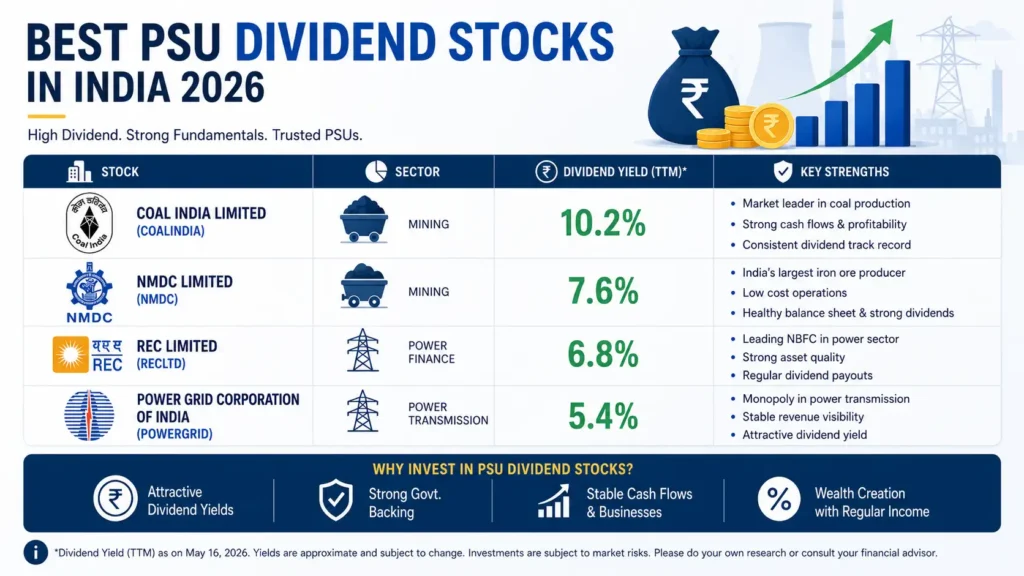
PSU (Public Sector Undertaking) stocks dominate India’s dividend landscape. Here is why:
- DIPAM mandates a minimum dividend payout of 30% of net profit or 4% of net worth.
- PSUs in sectors like energy, mining, and finance generate substantial free cash flow.
- Government depends on PSU dividends to manage its fiscal deficit.
Top PSU Dividend Stocks in 2026:
| Company | Sector | Approx. Yield | Key Characteristic |
|---|---|---|---|
| Coal India | Mining | 6–7% | World’s largest coal producer |
| ONGC | Oil & Gas | 5–6% | Largest oil explorer |
| BPCL | Oil & Gas | 6–7.5% | Top OMC |
| IOC | Oil & Gas | 5–7% | Largest refiner |
| NMDC | Mining | 5–7% | Iron ore monopoly |
| REC | Finance | 5–6% | Power sector NBFC |
| PFC | Finance | 4–5% | Infrastructure finance |
| Power Grid | Utilities | 4–5% | Regulated transmission |
| GAIL | Gas | 4–5% | Gas pipeline monopoly |
| Coal India | Mining | 6–7% | Maharatna PSU |
Source: Axis Securities research, Business Standard reports, NSE screener data (2025–2026). Always verify at nseindia.com.
PSU stocks also tend to trade at lower price-to-earnings (P/E) ratios compared to private-sector peers. This combination of low valuations and high yields is why income investors often overweight PSUs in dividend portfolios.
High Dividend Yield Stocks Under ₹100
For investors with smaller capital or those who prefer affordable entry prices, several dividend-paying stocks have traded below the ₹100 mark:
| Company | Sector | Approx. Price Band | Key Note |
|---|---|---|---|
| Indian Oil Corporation (IOC) | Oil & Gas | ₹100–150 | Dividend yield ~5–7% |
| PTC India | Power Trading | ₹150–200 | Yield ~5–7% |
| Bank of India | Banking | ₹80–120 | PSU bank with growing dividends |
| NMDC | Mining | ₹200–250 | Yield ~5–7% (slightly above ₹100) |
| SAIL (Steel Authority of India) | Steel | ₹80–130 | Cyclical but decent yield in good years |
| Canara Bank | Banking | ₹80–120 | Growing PSU bank dividends |
Note: Share prices are approximate and fluctuate daily. Verify current prices and yields on BSE (bseindia.com) or NSE (nseindia.com). Stocks trading under ₹100 may also reflect lower valuations for legitimate business reasons always check fundamentals before investing.
For stocks under ₹100, IOC stands out as the most widely held. Indian Oil Corporation was priced in the ₹128 range as per Axis Securities data cited in Business Standard (April 2025), with a dividend yield of around 5%.
How to Choose Dividend Stocks
Choosing dividend stocks is not as simple as picking the highest yield. Here are the key factors to evaluate:
1. Dividend Payout Ratio
This is the percentage of earnings paid out as dividends.
Payout Ratio = Dividend Per Share ÷ Earnings Per Share × 100
A payout ratio above 80–90% may not be sustainable unless the company has very stable, non-cyclical earnings. A ratio of 40–60% is generally considered healthy, leaving room for reinvestment and dividend growth.
2. Free Cash Flow
A company paying dividends from borrowings rather than real cash flow is a red flag. Always check whether the company’s free cash flow (operating cash flow minus capex) comfortably covers the dividend payment.
3. Earnings Stability
Companies with volatile earnings like commodity producers can cut dividends in bad years. Look for businesses with predictable revenue, like utilities (Power Grid, NTPC) or regulated infrastructure (Petronet LNG).
4. Debt Levels
High debt consumes cash flow that could otherwise fund dividends. A company with a debt-to-equity ratio above 3× needs scrutiny. Note that financial companies (REC, PFC) naturally carry higher leverage compare within sector.
5. Return on Equity (ROE)
A high and consistent ROE (above 15%) suggests that the company is efficiently deploying capital. It also suggests future earnings (and dividend) growth is more likely.
6. Dividend Consistency
Look for companies that have paid uninterrupted dividends for 5+ years. Coal India, ITC, TCS, ONGC, and NMDC all have long dividend histories. You can verify past dividend records directly on BSE India (bseindia.com) under the corporate actions section.
7. Sector Risk
High-yield stocks often cluster in cyclical sectors (metals, oil). Diversify across defensive sectors (FMCG, utilities, IT) to protect against commodity downturns.
Advantages of Dividend Investing
Dividend investing offers several real advantages for Indian investors:
- Regular passive income: Dividends arrive regardless of market conditions. This is especially valuable in bear markets when capital gains are unavailable.
- Compounding returns: If you reinvest dividends to buy more shares (DRIP or manual reinvestment), compounding accelerates long-term wealth creation.
- Lower volatility: Dividend-paying companies tend to be more established with stable earnings, making their stocks less volatile than high-growth counterparts.
- Signal of financial health: A company that consistently raises dividends is broadcasting confidence in its future earnings. Dividend cuts, on the other hand, are early warning signals.
- Inflation hedge (through dividend growth): Growing dividends preserve purchasing power over time in a way that fixed deposits cannot.
- Psychological benefit: Receiving regular income from equity holdings helps investors stay the course during market downturns without panic selling.
Risks of High Dividend Stocks
High yields are not always what they seem. Watch out for these risks:
- Dividend traps: Sometimes a very high yield (above 10%) is the result of a sharply fallen stock price. If the business is deteriorating, the dividend will likely be cut.
- Commodity cyclicality: Stocks like Vedanta and NMDC pay high dividends when commodity prices are elevated — but can cut dividends sharply in a downturn.
- Government policy risk: PSU dividend payouts depend partly on government fiscal needs. If policy changes, the payout may shift.
- Opportunity cost: A stock with a 6% dividend yield but zero capital growth may underperform a 3% yield stock with 15% price appreciation over five years. Always think total return.
- Leverage risk: Companies with high debt (like Vedanta) can face dividend cuts when interest costs rise or when refinancing becomes expensive.
- Sector concentration: If you hold Coal India, ONGC, BPCL, IOC, and GAIL, you have a portfolio heavily concentrated in fossil fuels — a meaningful long-term risk.
Taxation of Dividend Income in India
Since the Finance Act 2020 abolished the Dividend Distribution Tax (DDT), dividends are now fully taxable in the hands of shareholders.
Key Rules (FY 2025–26 / AY 2026–27):
- Dividends are taxed as “Income from Other Sources” at your applicable income tax slab rate.
- TDS (Tax Deducted at Source): A company deducts 10% TDS before paying dividends. From 1 April 2025, TDS applies only when your total dividend from a single company exceeds ₹10,000 in a financial year (raised from ₹5,000 in earlier years under the Union Budget 2025).
- If PAN is not provided, TDS jumps to 20%.
- For NRIs, TDS is 20%, though Double Taxation Avoidance Agreement (DTAA) benefits may apply.
- You can claim TDS credit while filing your ITR — the TDS already deducted reduces your final tax liability.
- ITR reporting: Dividend income must be reported separately under “Income from Other Sources.” For AY 2026–27, quarter-wise disclosure is required to align with Form 26AS/AIS entries.
Example:
If you are in the 30% tax bracket and receive ₹1 lakh in dividends, your tax is ₹30,000. The company would have already deducted ₹10,000 TDS. You pay the remaining ₹20,000 while filing your ITR.
For the most accurate and current tax guidance, refer to the Income Tax Act, 1961 and consult a SEBI-registered financial advisor or Chartered Accountant. The Income Tax Department’s website (incometax.gov.in) is the official source.
Dividend Stocks vs Growth Stocks
Both have a place in a well-constructed portfolio but they serve different purposes.
| Parameter | Dividend Stocks | Growth Stocks |
|---|---|---|
| Income | Regular cash dividends | Minimal or no dividends |
| Capital Growth | Moderate | High potential |
| Risk | Generally lower (mature businesses) | Higher (early-stage or cyclical) |
| Best for | Retirees, passive income seekers | Younger investors, wealth builders |
| Examples | Coal India, ITC, Power Grid | Zomato, Nykaa, Tata Motors |
| Valuation | Often low P/E | Higher P/E (growth premium) |
| Tax treatment | Dividend taxed as income | Capital gains taxed separately |
A balanced approach: Many financial planners in India recommend a “core and satellite” strategy a core of dividend-paying blue-chips for income stability, supplemented by a smaller allocation to growth stocks for capital appreciation.
Also Read
- Adani Power Share Price Target 2026–2030 — 5 Shocking Facts Every Investor Must Know
- Defence Stocks in India 2026: Best Defence Shares to Watch, Buy & Track
- Merritronix IPO 2026: Complete Review, GMP, Price Band, Dates & Should You Apply?
- LIC Share Price Target 2026, 2027, 2028, 2029 & 2030 — Honest Analysis With Real Data
Frequently Asked Questions(FAQ)
Q.1. What is a good dividend yield in India?
Ans:- A dividend yield of 3–5% is generally considered healthy for large-cap Indian stocks. Yields above 6–7% from well-established companies like Coal India or ONGC are attractive, but always check whether the business is sustainable. A yield above 10% warrants extra scrutiny — it may indicate a dividend trap.
Q.2. Which Indian stock gives the highest dividend yield?
Ans:- As of May 2026, Vedanta Ltd, Coal India, BPCL, and Hindustan Zinc have been among the highest-yielding large-cap stocks. Smallcase research noted that Vedanta, Coal India, Hindustan Zinc, PTC India, and Castrol India had yields above 5% as of 22 May 2026. Yields fluctuate daily — check live data on NSE or BSE.
Q.3. Are dividend stocks safe?
Ans:- Dividend stocks from established companies with stable earnings (PSUs, blue-chip FMCG, IT) are generally considered lower-risk than growth stocks. However, no stock is risk-free. Dividend stocks can underperform if earnings decline or the payout is cut.
Q.4. How are dividends taxed in India in 2026?
Ans:- Dividends are taxed as “Income from Other Sources” at your slab rate. TDS at 10% applies if total dividends from a company exceed ₹10,000 in FY 2025–26. NRIs face 20% TDS. Always consult a CA for individual tax planning.
Q.5. What is the ex-dividend date and why does it matter?
Ans:- The ex-dividend date is the cut-off date. If you buy shares on or after the ex-dividend date, you do not receive that particular dividend. To qualify, you must own the shares before the ex-dividend date. You can track upcoming ex-dividend dates on the NSE India corporate actions calendar.
Q.6. What is the difference between interim and final dividend?
Ans:- An interim dividend is declared during the financial year (often in Q2 or Q3) without waiting for year-end results. A final dividend is declared at the AGM after the full year’s profit is confirmed. Some companies like TCS, Hindustan Zinc — pay both.
Q.7. Should I invest in dividend stocks for passive income?
Ans:- Yes, but with the right expectations. Dividend stocks are not a replacement for FDs or bonds in the short term — stock prices can fall. For long-term investors (5+ years), dividend stocks can provide a growing income stream that outpaces inflation.
Q.8. What is the dividend payout ratio?
Ans:- It is the percentage of earnings distributed as dividends. A payout ratio of 40–60% is generally sustainable. Hindustan Zinc has historically had one of the highest payout ratios among Indian corporates.
Q.9. Can PSU dividends be cut?
Ans:- Yes. Although DIPAM mandates a minimum payout, companies can pay below the mandated floor during loss years. Government fiscal policy can also influence the quantum of PSU dividend distributions.
Q.10. How do I find upcoming dividend dates for Indian stocks?
Ans:- Visit the NSE India website (nseindia.com) → Corporate Actions → Dividends, or BSE India (bseindia.com) → Corporate Actions. Both list ex-dates, record dates, and announced dividend amounts for all listed companies.
Q.11. Is dividend investing better than fixed deposits for Indian investors?
Ans:- It depends on your tax bracket and time horizon. FDs offer guaranteed returns and DICGC insurance. Dividend stocks offer higher potential returns but with price risk. For taxpayers in higher slabs (30%), dividend income and FD income are both taxed at slab rate, so the decision hinges on expected dividend growth and stock appreciation.
Q.12. What is the record date for dividends?
Ans:- The record date is the date on which a company checks its shareholder register to determine who receives the dividend. The ex-dividend date is typically one day before the record date in India (T+1 settlement). Shareholders on the record must hold shares before the ex-date.
Final Thoughts
Dividend investing is one of the most time-tested strategies in the Indian market. The best dividend yield stocks in India 2026 led by Coal India, Vedanta, Hindustan Zinc, BPCL, ONGC, and REC offer yields that comfortably beat inflation and many fixed-income options, while also giving you upside exposure to equity markets.
That said, yield alone is not a strategy. A sustainable dividend depends on stable earnings, manageable debt, strong free cash flow, and a company culture of returning capital to shareholders. The dividend history of a company available freely on NSE India and BSE India is one of the most honest indicators of financial health you can find.
Build your dividend portfolio in layers:
- A core of defensive high-yielders (Power Grid, NTPC, ITC)
- A layer of PSU income stocks (Coal India, REC, ONGC)
- A growth-plus-dividend component (TCS, HCL Technologies, Infosys)
Review your portfolio annually. Check ex-dividend dates. Report dividend income correctly in your ITR. And remember — dividends are evidence that a company is genuinely profitable. That, more than anything, is what makes dividend investing enduringly attractive.
Official Sources Used
- NSE India — nseindia.com (screeners, corporate actions, dividend history)
- BSE India — bseindia.com (corporate actions, company filings)
- Business Standard — Citing brokerage research from Axis Securities, Religare Broking, IDBI Capital Markets & Securities
- DIPAM (Ministry of Finance) — Guidelines on minimum PSU dividend payout
- Income Tax Act, 1961 — Dividend taxation provisions (Finance Act 2020, Union Budget 2025)
- Income Tax Department — incometax.gov.in
- Smallcase Research — High dividend yield NSE screener data (as of 22 May 2026)
- Upstox Market News — FY26 dividend data (Hindustan Zinc, ITC, Coal India comparisons)
- Nifty Dividend Opportunities 50 Index — NSE index methodology and return data
This article is for educational and informational purposes only. It does not constitute financial advice or a recommendation to buy or sell any securities. Always verify data from official sources (NSE India, BSE India, company annual reports) and consult a SEBI-registered financial advisor before making investment decisions. Dividend yields and stock prices change daily.