
Table of Contents
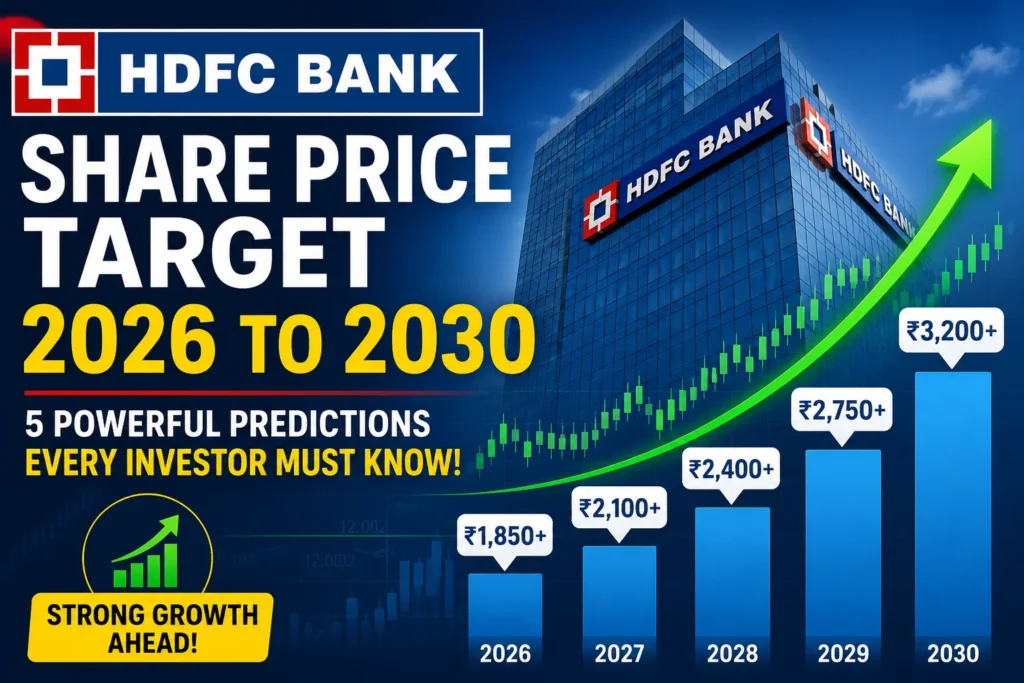
HDFC Bank Share Price Target 2026 to 2030
When I first looked at HDFC Bank’s share price, I had mixed feelings. On one hand, it is one of the most respected private sector banks in India. On the other hand, the stock has delivered very little to investors over the past few years.
If we look at the numbers, the 5-year stock price CAGR is around 0%, the 3-year CAGR is about -3%, and the 1-year return is nearly -24%. For a company of HDFC Bank’s quality, these returns may surprise many investors.
What makes the situation even more interesting is that the business itself has continued to grow strongly. Over the last five years, profit has increased at a CAGR of around 19%, while revenue has grown at about 22% annually. Earnings per share (EPS) have also risen significantly, from ₹24.85 in FY20 to ₹49.39 in FY26, almost doubling in six years.
In simple terms, the company has been performing well, but the stock price has not reflected that growth. This is why HDFC Bank has become one of the most closely watched banking stocks in India today.
As of June 1, 2026, HDFC Bank shares are trading at ₹743. During the last 52 weeks, the stock touched a high of ₹1,020 and a low of ₹727. With the share price currently close to its 52-week low, investors are asking an important question: is this a value opportunity for long-term investors, or is there a reason the market remains cautious?
So what is the HDFC Bank share price target for 2027, 2028, 2029, and 2030? Let us find out together. Simply. Honestly.
| Year | Minimum Target | Average Target | Maximum Target |
|---|---|---|---|
| 2026 | ₹780 | ₹860 | ₹950 |
| 2027 | ₹900 | ₹1,050 | ₹1,200 |
| 2028 | ₹1,100 | ₹1,300 | ₹1,500 |
| 2029 | ₹1,350 | ₹1,600 | ₹1,900 |
| 2030 | ₹1,600 | ₹2,000 | ₹2,500 |
Company Background
When people buy a house, they often take a home loan from a bank. The bank lends money and earns interest as the loan is repaid over many years. This basic model is how banks generate a large part of their income.
HDFC Bank does this on a massive scale. Its business includes home loans, car loans, personal loans, credit cards, savings accounts, fixed deposits, insurance products, and mutual fund distribution. Millions of customers use one or more of these services every day.
HDFC Bank Limited is India’s largest private sector bank by assets and one of the most valuable banks in the world by market capitalisation. The bank is headquartered in Mumbai and is listed on both the BSE (500180) and NSE (HDFCBANK).
A few numbers show the size of HDFC Bank’s operations:
- Market capitalisation of around ₹11.43 lakh crore, making it one of India’s largest listed companies.
- Around 15% share of total banking sector advances in India.
- Nearly 37% share of advances among private sector banks.
- One of only three systemically important banks in India because of its size and importance to the financial system.
- Among the leading banks involved in collecting direct and indirect taxes for the government.
The merger with HDFC Ltd in 2023 further strengthened the bank’s position. The combined entity gained a larger customer base, a bigger loan portfolio, and a stronger presence in the housing finance segment. This is one of the main reasons revenue and balance sheet figures increased sharply from FY24 onwards.
Today, HDFC Bank is deeply connected to India’s financial system. From salary accounts and savings accounts to home loans, credit cards, and investment products, the bank serves millions of individuals and businesses across the country. Its scale, strong brand, and consistent growth are the key reasons investors closely track HDFC Bank share price targets for the coming years.
For official information, visit HDFC Bank’s official website.
Current Share Price and Key Data From Screener
Based on Screener.in data as of June 1, 2026:
| Metric | Value |
|---|---|
| Current Price | ₹743 |
| 52-Week High / Low | ₹1,020 / ₹727 |
| Market Cap | ₹11,43,179 Crore |
| Stock P/E | 15.0 |
| Book Value | ₹378 |
| Dividend Yield | 1.75% |
| ROCE | 7.04% |
| ROE | 13.8% |
| Face Value | ₹1.00 |
| Listed On | BSE: 500180 / NSE: HDFCBANK |
A few things jump out immediately.
The P/E of 15 is actually quite cheap for HDFC Bank historically. This bank used to trade at 25-30x earnings for most of the last decade. At 15x, it is at a significant discount to its own historical average. This is one of the core reasons some analysts think this is a strong buying opportunity right now.
The stock is trading at just 1.97x book value (₹743 price vs ₹378 book value). For a bank like HDFC Bank, this is very low. ICICI Bank and Kotak Bank trade at significantly higher price-to-book ratios. This valuation gap is something serious investors are paying close attention to.
The dividend yield of 1.75% is decent and the dividend payout ratio has been growing consistently, reaching 31% in FY26. This is a bank that shares profits with shareholders.
For live tracking of HDFC Bank’s financials, check Screener.in’s HDFC Bank page best free tool for Indian stock research.
HDFC Bank Quarterly Results
Here is the recent quarterly picture:
| Quarter | Revenue (₹ Cr) | Net Profit (₹ Cr) | EPS (₹) |
|---|---|---|---|
| Mar 2025 | 86,779 | 19,285 | 12.31 |
| Jun 2025 | 87,372 | 17,090 | 10.60 |
| Sep 2025 | 86,994 | 20,364 | 12.76 |
| Dec 2025 | 87,067 | 20,691 | 12.87 |
| Mar 2026 | 87,182 | 21,074 | 13.22 |
The March 2026 quarter is encouraging net profit of ₹21,074 crore, up 8.05% year-on-year. EPS of ₹13.22 is the highest in the last several quarters. Revenue has been remarkably stable hovering around ₹87,000 crore every quarter, showing the bank’s consistency.
Full Year FY26 Annual Highlights:
| Metric | FY24 | FY25 | FY26 | Growth |
|---|---|---|---|---|
| Revenue (₹ Cr) | 2,83,649 | 3,36,367 | 3,48,615 | +4% |
| Net Profit (₹ Cr) | 65,446 | 73,440 | 79,219 | +8% |
| EPS (₹) | 42.16 | 46.26 | 49.39 | +7% |
| Dividend Payout % | 23% | 24% | 31% | Growing |
Compounded Growth Rates :
| Period | Sales Growth | Profit Growth | Stock Price CAGR | ROE |
|---|---|---|---|---|
| 10 Years | 19% | 20% | 10% | 16% |
| 5 Years | 22% | 19% | 0% | 15% |
| 3 Years | 27% | 18% | -3% | 15% |
| TTM | 4% | 8% | -24% | 14% |
This table tells a very important story. The business has been growing consistently 19-20% profit CAGR over 10 years is excellent. But the stock price has massively underperformed 0% over 5 years, -3% over 3 years, -24% in just the last year.
This disconnect between business performance and stock price is the core investment thesis for HDFC Bank right now. When a great business is ignored by the market, patient investors eventually get rewarded.
HDFC Bank Share Price Target 2027
For 2027, the HDFC Bank share price target will largely depend on how well the bank converts its strong financial performance into renewed investor confidence.
The biggest factor is the HDFC Ltd merger. Most of the integration work is now complete, and investors expect the benefits to become more visible in FY27 through better earnings and operational efficiency.
Loan growth is another key trigger. After the merger, HDFC Bank deliberately slowed lending to improve its credit-to-deposit ratio. With balance sheet pressures easing, management is now focusing on accelerating loan growth again.
Net Interest Margins (NIMs), which came under pressure after the merger, are also showing signs of stabilisation. Any improvement in margins could support stronger profitability in the coming years.
Finally, foreign investor sentiment will be important. FII ownership has fallen from over 52% in 2023 to around 44% by March 2026. If global investors start increasing their exposure again, HDFC Bank could see a meaningful re-rating.
Overall, FY27 could be a turning point if loan growth picks up, margins improve, and investor confidence returns.
| Scenario | Target Price |
|---|---|
| Conservative (slow recovery) | ₹820 – ₹920 |
| Base Case (gradual re-rating) | ₹950 – ₹1,100 |
| Optimistic (strong FII return) | ₹1,150 – ₹1,250 |
My honest take: At ₹743 with FY26 EPS of ₹49.39, the stock is at just 15x earnings. If the market re-rates it even to 20x which was completely normal for HDFC Bank for most of the last decade the stock reaches ₹988 without any earnings growth at all. With 8-10% earnings growth, a 2027 target of ₹1,000-₹1,100 is genuinely achievable.
HDFC Bank Share Price Target 2028
By 2028, the merger-related concerns that have weighed on HDFC Bank for several years should largely be behind it. The merger with HDFC Ltd in 2023 created one of the largest financial institutions in India, but it also temporarily affected key metrics such as Return on Equity (ROE) and the credit-to-deposit ratio. By FY28, investors will be looking for these numbers to return to their historical levels.
Another major growth driver is India’s long-term credit expansion. Despite being one of the world’s fastest-growing economies, India’s household debt-to-GDP ratio remains much lower than that of developed countries. As more families take home loans, vehicle loans, education loans, and personal loans, the demand for credit is expected to rise steadily over the next decade.
HDFC Bank is well positioned to benefit from this trend because of its strong brand, large customer base, and leadership in private sector lending. If India’s credit market continues to expand as expected, HDFC Bank could capture a significant share of that growth and strengthen its position further by 2028.
| Scenario | Target Price |
|---|---|
| Conservative | ₹1,000 – ₹1,150 |
| Base Case | ₹1,200 – ₹1,400 |
| Optimistic | ₹1,450 – ₹1,600 |
If EPS grows from ₹49.39 today to ₹65-70 by FY28 (at 15% annual growth) and P/E normalises to 20x, the stock naturally reaches ₹1,300-₹1,400. This is not a fantasy it is simply mean reversion for one of India’s best banks.
HDFC Bank Share Price Target 2029
By 2029, HDFC Bank’s story is about sustained compounding. This bank has grown profits at 20% CAGR for 10 years. Even if growth moderates to 12-15% annually from the current larger base, the absolute earnings numbers will be significantly higher.
India’s banking sector penetration is expected to deepen significantly by 2030. Financial inclusion, digital banking, UPI-linked credit, and the formalisation of the economy all point to more and more Indians using banking services and HDFC Bank has the infrastructure to capture that growth.
| Scenario | Target Price |
|---|---|
| Conservative | ₹1,250 – ₹1,450 |
| Base Case | ₹1,500 – ₹1,700 |
| Optimistic | ₹1,800 – ₹2,000 |
DII ownership has been consistently growing from 26.75% (Jun 2023) to 40.14% (Mar 2026). This shows Indian mutual funds and institutions are steadily accumulating HDFC Bank shares. When FIIs return in larger numbers, combined with DII buying, the demand-supply situation for the stock looks very positive.
HDFC Bank Share Price Target 2030
The 2030 picture for HDFC Bank is the most exciting of all. India is expected to become the world’s third-largest economy by 2030. As the economy grows, banking grows with it. And HDFC Bank as India’s largest private bank sits right at the centre of that story.
By 2030, if HDFC Bank achieves EPS of ₹80-90 (growing at 10-12% from today’s ₹49.39), and the market values it at 22-25x earnings (still conservative by historical standards), the stock target becomes ₹1,760 to ₹2,250.
| Scenario | Target Price |
|---|---|
| Conservative | ₹1,500 – ₹1,700 |
| Base Case | ₹1,800 – ₹2,100 |
| Optimistic | ₹2,200 – ₹2,600 |
Some external research models suggest ₹2,500+ by 2030 for HDFC Bank. That requires both earnings growth AND valuation re-rating — but given the current depressed P/E of 15x, both happening simultaneously is quite plausible.
Full Target Summary:
| Year | Conservative | Base Case | Optimistic |
|---|---|---|---|
| 2027 | ₹820 – ₹920 | ₹950 – ₹1,100 | ₹1,150 – ₹1,250 |
| 2028 | ₹1,000 – ₹1,150 | ₹1,200 – ₹1,400 | ₹1,450 – ₹1,600 |
| 2029 | ₹1,250 – ₹1,450 | ₹1,500 – ₹1,700 | ₹1,800 – ₹2,000 |
| 2030 | ₹1,500 – ₹1,700 | ₹1,800 – ₹2,100 | ₹2,200 – ₹2,600 |
Pros of HDFC Bank Share
1. Consistent Profit Growth — 19% CAGR Over 5 Years Screener specifically highlights this as a pro. Growing profits at 19% CAGR over 5 years from a base this large is genuinely impressive. Most large banks globally would be delighted with 8-10%.
2. Healthy Dividend Payout of 26.1% Median HDFC Bank has been consistently sharing profits with shareholders. The dividend payout ratio has been growing from 23% in FY24 to 31% in FY26. At a current yield of 1.75%, it is not a dividend stock, but the growing payout is a positive signal.
3. Strong 10-Year Sales Growth of 19% Screener highlights the median 10-year sales growth of 16.3%. Very few Indian companies let alone banks can claim this kind of sustained top-line growth over a full decade.
4. India’s Largest Private Bank — 37% Private Sector Market Share This is an extraordinary competitive position. More than one-third of all private banking advances in India go through HDFC Bank. Building this kind of customer trust and distribution took decades. It cannot be replicated quickly by any competitor.
5. Systemically Important Bank Status Being one of only 3 systemically important banks in India means HDFC Bank has the implicit backing of the government and RBI in any crisis situation. This provides a level of stability that smaller banks simply cannot match.
6. DII Ownership Growing Strongly DII ownership has grown from 26.75% to 40.14% over just 3 years. Indian mutual funds who are known for long-term, fundamentals-based investing are consistently buying HDFC Bank. That is a strong vote of confidence.
7. Cheap Valuation by Historical Standards A P/E of 15x for a bank that has grown profits at 20% for 10 years is genuinely cheap. HDFC Bank historically traded at 25-30x earnings. The current discount represents either a real opportunity or a signal that the market knows something and understanding which one it is, is the key research question.
8. Massive Balance Sheet Post-Merger Total assets of ₹49 lakh crore make HDFC Bank one of the largest financial institutions in Asia. Scale brings efficiency, pricing power, and access to the cheapest funding all of which support long-term profitability.
Cons and Risks
1. Low Interest Coverage Ratio Screener flags this as a concern. For a bank, this means the interest HDFC Bank pays on its borrowings is high relative to its operating earnings from core banking. This is partly a structural banking issue but worth monitoring closely.
2. Contingent Liabilities of ₹27,80,601 Crore This is a massive number. Contingent liabilities are potential obligations that may or may not crystallise things like guarantees, letters of credit, and derivative contracts. If even a small fraction of these materialise, it could impact the bank significantly.
3. Other Income Dependency — ₹1,46,848 Crore Screener flags that earnings include a large other income component of ₹1,46,848 crore. This includes treasury gains, fee income, and other non-core items. If this drops due to falling bond prices or reduced fee income reported profits could disappoint.
4. Stock Has Been a Terrible Performer Recently Let me be blunt. If you had bought HDFC Bank 5 years ago, you would have made exactly 0% return on price. In a market where the Nifty 50 nearly doubled, HDFC Bank sat still. There must be a reason the market is not excited. The post-merger integration is still creating short-term pressure on key metrics like ROE (now 13.8% vs 17%+ before merger).
5. ROE Has Been Declining ROE went from 17% consistently through most of the decade to 14% in recent years. The merger with HDFC Ltd diluted ROE because the new capital structure is much larger. Until ROE recovers back to 17-18%, the stock may struggle to re-rate significantly.
6. FII Selling Pressure FII holding has dropped from 52.13% (Sep 2023) to 44.05% (Mar 2026). Foreign investors have been consistently selling HDFC Bank. As long as FII selling continues, it creates an overhang on the stock price. The question is when does FII selling stop and reverse?
7. Internal Probe News A recent Screener announcement noted HDFC Bank clarifying a media report about a ₹45 crore interest payment probe to a state transport firm. While the bank said there is no material impact, any compliance or governance concern in a banking stock deserves careful attention.
8. Competition is Intensifying ICICI Bank has been taking market share aggressively in the last 3-4 years with stronger digital offerings and better growth rates. ICICI Bank’s stock has significantly outperformed HDFC Bank in the same period. If this trend continues, HDFC Bank’s premium valuation may never return.
Peer Comparison — How HDFC Bank Stacks Up
| Bank | CMP (₹) | P/E | Market Cap (₹ Cr) | Div Yield | Q4 Net Profit (₹ Cr) | ROCE% |
|---|---|---|---|---|---|---|
| HDFC Bank | 743 | 15.0 | 11,43,179 | 1.75% | 21,074 | 7.04 |
| ICICI Bank | 1,240 | 16.4 | 8,89,185 | 0.89% | 15,681 | 7.20 |
| Axis Bank | 1,276 | 15.0 | 3,96,354 | 0.08% | 7,642 | 6.24 |
| Kotak Bank | 377 | 19.7 | 3,74,893 | 0.13% | 5,423 | 6.93 |
| Yes Bank | 23 | 20.6 | 72,157 | 0.00% | 1,082 | 5.98 |
HDFC Bank has by far the highest quarterly net profit (₹21,074 crore vs ICICI Bank’s ₹15,681 crore) and the largest market cap. Its profitability leadership is clear and undisputed.
However, ICICI Bank trades at 16.4x P/E vs HDFC Bank’s 15x a gap that has been narrowing. The market is now valuing ICICI Bank almost as highly as HDFC Bank, which was unthinkable 5 years ago.
HDFC Bank has the best dividend yield at 1.75% among large private sector peers which makes it attractive for investors who want some income while they wait for price recovery.
Should You Invest in HDFC Bank Share?
If you are a long-term patient investor (3-5 years): HDFC Bank at ₹743 with a P/E of 15x and EPS growing at 8-10% per year is genuinely interesting. The business quality is exceptional. The valuation is cheap by historical standards. The post-merger disruption is largely behind us. If the stock simply goes back to 20x P/E which it deserves that is a 33% return without any earnings growth. With earnings growth, the potential is much higher.
If you want quick gains in 6-12 months: This might disappoint you. The stock has been drifting sideways and down for years. The recovery, when it comes, will likely be gradual not a sudden spike.
If you want regular income: The 1.75% dividend yield is okay but not exciting. Better to look at something with 3-4% yield if income is your primary goal.
If FII behaviour worries you: Watch the shareholding pattern carefully every quarter. As long as FIIs are net sellers, the stock faces structural headwinds. The moment FII selling stops and reverses, the stock could move quickly.
Think of HDFC Bank like a giant well-built house that has been ignored by buyers for a few years. The house itself is in excellent condition strong foundation, well-maintained, growing rent every year. It is just that nobody is excited about it right now. But a house this well-built does not stay undervalued forever. Patient buyers eventually recognise the value.
Key things to track every quarter:
- Is ROE recovering back toward 16-17%?
- Is FII ownership stabilising or increasing?
- Is EPS growth accelerating from current 8%?
- Are there any NPA (Non-Performing Asset) stress signals?
- Is the credit-to-deposit ratio normalising?
For India’s banking sector policies, RBI guidelines, and regulatory updates that affect HDFC Bank directly, you can follow the Reserve Bank of India’s official website.
Also Read
- Adani Power Share Price Target 2026 to 2030 — 5 Powerful Predictions
- LIC Share Price Target 2026 to 2030 — Honest Analysis With Real Data
- Best Dividend Yield Stocks in India 2026: Top 20 High Dividend Paying Shares
FAQ
Q1. What is the HDFC Bank share price target for 2027?
Ans:- The HDFC Bank share price target for 2027 is expected to be around ₹950 to ₹1,100 in the base case. If the P/E re-rates toward its historical average of 20-25x, the stock could reach ₹1,150 to ₹1,250 by end of 2027.
Q2. What is the HDFC Bank share price target for 2028?
Ans:- The HDFC Bank share price target for 2028 is estimated between ₹1,200 and ₹1,400 in normal market conditions. If post-merger synergies fully materialise and ROE recovers, the stock may push toward ₹1,500 to ₹1,600.
Q3. What is the HDFC Bank share price target for 2030?
Ans:- The HDFC Bank share price target for 2030 ranges from ₹1,800 to ₹2,100 in the base scenario. In a strongly optimistic case with P/E re-rating and consistent earnings growth, the stock could reach ₹2,200 to ₹2,600.
Q4. Is HDFC Bank a good long-term investment?
Ans:- HDFC Bank looks very interesting for long-term investors because of its exceptional franchise quality, consistent profit growth of 19% over 5 years, reasonable P/E of 15x, and growing dividend payout. The key risk is continued ROE dilution post-merger and ongoing FII selling pressure.
Q5. Why has HDFC Bank share price fallen so much?
Ans:- HDFC Bank stock has underperformed because of post-merger integration challenges after merging with HDFC Ltd in 2023. The merger increased the balance sheet dramatically but temporarily depressed key metrics like ROE and net interest margins. FII selling has also created consistent pressure on the stock.
Q6. What is the current HDFC Bank share price?
Ans:- As of June 1, 2026, the HDFC Bank share price is ₹743 on NSE (HDFCBANK) and BSE (500180). The 52-week high is ₹1,020 and the 52-week low is ₹727.
Q7. Does HDFC Bank pay a good dividend?
Ans:- HDFC Bank pays a dividend yield of 1.75% currently. The dividend payout ratio has been growing — reaching 31% in FY26. While not a high-yield dividend stock, the growing payout is a positive sign for long-term shareholders.
Q8. What is HDFC Bank’s EPS for FY26?
Ans:- HDFC Bank’s EPS for FY26 is ₹49.39 — up from ₹46.26 in FY25 and ₹42.16 in FY24. EPS has been growing consistently year after year which is why many analysts consider the current valuation attractive.
Q9. How does HDFC Bank compare with ICICI Bank?
Ans:- HDFC Bank has higher absolute profits (₹21,074 crore vs ICICI Bank’s ₹15,681 crore in Q4 FY26) and a better dividend yield (1.75% vs 0.89%). However, ICICI Bank has been growing faster in recent years and its stock has significantly outperformed HDFC Bank. HDFC Bank’s P/E of 15x is slightly lower than ICICI Bank’s 16.4x.
Q10. What is HDFC Bank’s promoter holding? H
Ans:- DFC Bank has zero promoter holding as of March 2026. After the merger with HDFC Ltd, the combined entity has no single promoter group. Instead, institutional investors dominate — FIIs hold 44.05%, DIIs hold 40.14%, and public shareholders hold 15.64%.
Disclaimer: I wrote this article only to share information and help you understand this stock better. The price targets I mentioned are based on publicly available data,, analyst reports, and my own honest opinion. I am not a SEBI-registered advisor. Please do not make any investment decision based only on what I have written here. Always consult a qualified financial advisor before investing. Stock markets carry risk and past performance never guarantees future returns. Everything I have shared here is purely educational your money, your responsibility. Please invest wisely.