

If you have ever overheard people talking about Sensex going up or Nifty crashing, or seen news headlines about the share market hitting an all-time high — and wondered what any of it actually means — you are in the right place.
Every company in this world needs funds to keep its business running smoothly. When the company does not have enough money from its own earnings, it asks people to invest in the business.
By investing, ordinary people like you and me become partial owners of the company. If the company performs well, investors can also earn profits.
This is how the stock market works at a basic level, and understanding this concept is the first step in learning investing.
The stock market can feel Scary when you see it for the first time. All those numbers, charts, and technical terms make it seem like something only suited for finance experts or wealthy businessmen. But honestly? It is not that complicated once someone breaks it down properly.
In this guide, we are going to explain everything from scratch — what is share market and stock market, what is stock exchange, what is trading in stock market, and what is Nifty 50 — in plain, simple language that any beginner can follow.
Let us get started.
Table of Contents
What Is Share Market and Stock Market?
Let us start with the most basic question — what exactly is the stock market, and is it the same as the share market?
Yes, share market and stock market mean the same thing. In India, people commonly use both terms interchangeably. The share market is simply a marketplace where shares of publicly listed companies are bought and sold.
Now what is a share? Think of it this way.
Imagine your friend starts a business selling homemade snacks. The business grows, and now she wants to expand — open a bigger kitchen, hire staff, and start delivering across the city. But she does not have enough money to do all of this alone. So she decides to divide her business into 1,000 equal pieces and sell each piece for ₹100.
You buy 10 pieces for ₹1,000. Now you own 1% of her business. Those pieces are called shares — and you are now a shareholder.
This is exactly how the stock market works, but on a massive scale. Companies like Reliance, Tata, Infosys, and HDFC Bank have divided their businesses into millions of shares and sold them to the public through the stock market.
When a company performs well and grows, its share price goes up — and the value of your investment increases. When it struggles, the price falls. This is how investors make money (or lose money) in the share market.
So in simple terms — the stock market is a regulated marketplace where millions of buyers and sellers come together to trade shares of listed companies every single day.
Why Do Companies List Their Shares in the Stock Market?
This is a question most beginners never think to ask — but it is important to understand.
Companies need money to grow. They can either take loans from banks (and pay interest) or they can raise money by selling shares to the public. When a company sells shares for the first time through the stock market, it is called an IPO — Initial Public Offering.
By listing on the stock market, companies get access to large amounts of capital from thousands of investors. In return, those investors get ownership in the company and a chance to profit as the company grows.
It is a win-win when things go well.
What Is Stock Exchange?
Now that you understand what the stock market is, let us talk about where all this buying and selling actually happens.
A stock exchange is the actual platform — the physical or digital marketplace — where shares are listed and traded. Think of a stock exchange like a massive, organized bazaar specifically for stocks and securities. Just like a vegetable market has a specific place where buyers and sellers meet to trade vegetables, a stock exchange is the specific place where investors buy and sell shares.
In India, there are two major stock exchanges:
NSE — National Stock Exchange The NSE is the largest stock exchange in India by trading volume. It was founded in 1992 and is headquartered in Mumbai. Most of the daily stock trading in India happens on the NSE. It is also home to the famous Nifty 50 index, which we will explain in detail shortly.
BSE — Bombay Stock Exchange The BSE is Asia’s oldest stock exchange, established all the way back in 1875. It is also located in Mumbai, on Dalal Street — the address that has become synonymous with Indian finance. The BSE is home to the Sensex index, which tracks the performance of the top 30 companies listed on it.
Both exchanges list thousands of companies. Most large companies are listed on both NSE and BSE simultaneously. For practical purposes as a beginner investor, you do not need to choose between them — your broker handles that automatically when you place an order.
The key thing to understand is this: you cannot walk into a stock exchange and buy shares directly. You need a registered stockbroker — or today, a brokerage app like Zerodha, Groww, or Upstox — to access the exchange and place your trades on your behalf.
How does a stock exchange actually work?
When you place a buy order for 10 shares of Infosys, your broker sends that order to the exchange. The exchange’s system matches your buy order with someone else who wants to sell those same 10 shares at your price. Once matched, the trade is executed. This entire process happens electronically within seconds today.
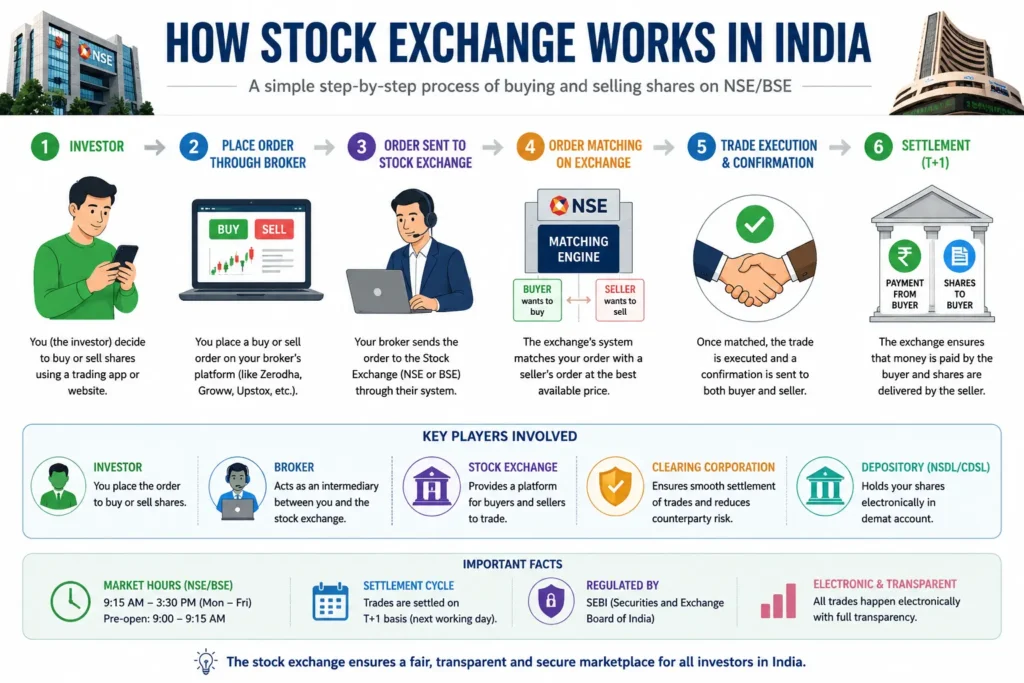
The stock exchange also ensures that both parties fulfill their obligations — the seller delivers the shares and the buyer pays the money. This is managed through a settlement system. In India, stock trades currently settle on a T+1 basis, which means the trade is settled the next working day after it is executed.
What Is Trading in Stock Market?
When people talk about trading in the stock market, they simply mean the activity of buying and selling shares. But there is a lot more to it than that one-line definition.
Trading in the stock market can mean very different things depending on your approach, your goals, and how long you intend to hold your investments.
Types of Trading in Stock Market
1. Delivery Trading (Investing)
This is the most straightforward form. You buy shares, they are delivered to your demat account, and you hold them for as long as you want — days, months, or even years. This is what most long-term investors do. You are not just buying a piece of paper; you genuinely own that percentage of the company for as long as you hold the shares.
If you buy 100 shares of Tata Motors today and hold them for two years, you participate in the company’s growth through rising share prices and dividends.
2. Intraday Trading
Intraday trading means you buy and sell shares within the same trading day. You do not take delivery of the shares — you are simply trying to profit from the price movement that happens during market hours (9:15 AM to 3:30 PM on Indian exchanges).
For example, you buy 500 shares of a company at ₹200 in the morning and sell them at ₹210 by afternoon. You make ₹5,000 in a few hours — but you also risk losing money if the price moves against you.
Intraday trading requires experience, discipline, and a clear strategy. It is not recommended for absolute beginners because the risks are high and losses can happen very quickly.
3. Swing Trading
Swing traders hold stocks for a few days to a few weeks, trying to capture short to medium-term price movements. It sits somewhere between intraday trading and long-term investing.
4. F&O Trading (Futures and Options)
Futures and Options are derivative instruments — their value is derived from an underlying stock or index. F&O trading is more complex and carries higher risk. SEBI data shows that the majority of individual traders in the F&O segment lose money. This is something beginners should approach only after gaining significant experience in regular stock trading.
When Is the Stock Market Open in India?
Indian stock markets — both NSE and BSE — are open on weekdays (Monday to Friday) from 9:15 AM to 3:30 PM IST. Markets are closed on weekends and on designated market holidays declared by the exchanges each year.
There is also a pre-market session from 9:00 AM to 9:15 AM where orders can be placed but are not immediately executed — they are matched at the start of regular trading hours.
What Is Nifty 50?
You have definitely heard this term on the news — “Nifty fell 200 points today” or “Nifty hits record high.” But what exactly is Nifty 50 and why does everyone keep talking about it?
Nifty 50 is the benchmark stock market index of the National Stock Exchange (NSE) of India. It tracks the performance of the top 50 largest and most actively traded companies listed on the NSE across 13 different sectors of the Indian economy.
Think of Nifty 50 as a report card for the Indian stock market. Instead of tracking all 2,000+ companies listed on the NSE (which would be impossible to follow), Nifty 50 picks the top 50 most important companies and uses their combined performance to represent the health of the overall market.
If Nifty 50 goes up — it generally means the Indian economy and corporate sector are doing well and investors are feeling confident. If Nifty 50 falls — it signals uncertainty, poor earnings, or negative economic news.
Which Companies Are in Nifty 50?
The Nifty 50 includes India’s biggest and most important companies across sectors like banking, technology, energy, automobiles, pharmaceuticals, and consumer goods. Some well-known names include:
- Reliance Industries
- HDFC Bank
- Infosys
- TCS (Tata Consultancy Services)
- ICICI Bank
- Larsen & Toubro
- Bajaj Finance
- Hindustan Unilever
- Wipro
- Maruti Suzuki
The composition of Nifty 50 is reviewed every six months. Companies that no longer meet the criteria are replaced by better-performing ones.
How Is Nifty 50 Calculated?
Nifty 50 is calculated using a method called free-float market capitalization. Without going too deep into the math — it means that companies with larger market values carry more weight in the index. So when Reliance Industries’ stock moves significantly, it has a bigger impact on Nifty than a smaller company in the index.
What Is the Difference Between Nifty and Sensex?
Both Nifty and Sensex are stock market indices that measure market performance, but they belong to different exchanges and track different numbers of companies.
| Nifty 50 | Sensex | |
|---|---|---|
| Exchange | NSE | BSE |
| Companies Tracked | Top 50 | Top 30 |
| Base Year | 1995 | 1978-79 |
| Base Value | 1,000 | 100 |
Both indices generally move in the same direction because they track similar large-cap Indian companies. When one goes up, the other almost always does too.
How Does the Stock Market Affect Everyday Indians?
Even if you never buy a single share, the stock market affects your life in more ways than you might realize.
Your EPF and NPS retirement funds are partly invested in equities through the stock market. When markets perform well, your retirement corpus grows faster.
Mutual funds — which millions of Indians invest in through SIPs — are directly linked to stock market performance. The returns on equity mutual funds depend entirely on how the underlying stocks perform.
Business confidence across the economy is influenced by stock market sentiment. When markets are doing well, companies invest more, hire more, and expand — which creates jobs and economic growth.
Understanding the stock market is no longer something only traders and investors need to do. It is basic financial literacy for every working Indian.
How Can a Beginner Start Investing in the Stock Market?
If you have read this far and you are feeling ready to take your first step, here is a simple roadmap:
Step 1 — Open a Demat and Trading Account You need a demat account to hold shares and a trading account to buy and sell them. Most brokers open both simultaneously. Popular options in India include Zerodha, Groww, Upstox, and Angel One. The process is fully online and takes 15 to 30 minutes.
Step 2 — Complete Your KYC You will need your PAN card, Aadhaar card, bank account details, and a selfie or signature for verification.
Step 3 — Add Funds to Your Trading Account Transfer money from your bank account to your trading account using UPI, net banking, or NEFT.
Step 4 — Start With Index Funds or Blue-Chip Stocks Do not start by picking random stocks or trading intraday. Begin with Nifty 50 index funds or well-established blue-chip companies that have a strong track record. Learn as you invest.
Step 5 — Keep Learning The stock market rewards those who keep educating themselves. Read, follow market news, understand the businesses you invest in, and never invest money you cannot afford to lose.
Key Takeaways
Let us quickly summarize what we have covered in this guide:
- Share market and stock market are the same thing — a marketplace where shares of publicly listed companies are bought and sold
- Companies list their shares on the stock market to raise money for growth through an IPO
- A stock exchange like NSE or BSE is the actual regulated platform where trading happens
- Trading in the stock market can mean delivery trading, intraday trading, swing trading, or F&O — each with different risk levels and time horizons
- Nifty 50 is India’s most important stock market index, tracking the top 50 companies on the NSE and representing the overall health of the Indian market
- Indian stock markets are open Monday to Friday from 9:15 AM to 3:30 PM IST
The stock market is not a get-rich-quick scheme and it is not a gambling casino — though many people treat it like one. When approached with patience, knowledge, and a clear strategy, it is one of the most powerful tools available to build long-term wealth in India.
Start small, learn continuously, and give your investments time to grow.
Frequently Asked Questions(FAQ)
1. What is the difference between share market and stock market?
Ans:- There is no difference. Share market and stock market mean exactly the same thing in India. Both refer to the marketplace where shares of publicly listed companies are bought and sold.
2. What is a stock exchange in India?
Ans:- A stock exchange is the regulated platform where stocks are listed and traded. India has two major stock exchanges — the NSE (National Stock Exchange) and the BSE (Bombay Stock Exchange), both located in Mumbai.
3. What is trading in stock market for beginners?
Ans:- Trading simply means buying and selling shares on the stock market. For beginners, delivery trading — where you buy shares and hold them for the long term — is the safest and most recommended starting point.
4. What is Nifty 50 in simple words?
Ans:- Nifty 50 is a stock market index that tracks the performance of the top 50 largest companies listed on the NSE. It acts as a barometer for the overall Indian stock market and economy.
5. How much money do I need to start investing in the Indian stock market?
Ans:- You can start with as little as ₹500 or even less. There is no minimum investment requirement for buying stocks in India. You can buy even one share of a company as long as you have the money to pay for it.
6. Is the stock market safe for beginners? The stock market carries risk — share prices can go up and down. However, long-term investing in diversified blue-chip stocks or index funds has historically delivered strong returns for patient investors in India. The key is to invest only what you can afford, diversify, and never panic during market downturns.
Disclaimer: This article is for educational purposes only and does not constitute financial or investment advice. Stock market investments are subject to market risk. Please consult a SEBI-registered financial advisor before making any investment decisions.