
Table of Contents
NSE vs BSE — if you are new to the Indian stock market, these two names will follow you everywhere.
You see them on Zerodha, Groww, Upstox, Dhan. You hear them on TV. You read them in every investing article.
And honestly? When I first started learning about the stock market, I had no idea what the difference was. I thought they were the same thing with different names.
They are not. And once you understand the difference, everything about investing in India becomes much clearer.
So let me explain it to you — simply, without the complicated financial language.
What is NSE? (National Stock Exchange)
NSE stands for National Stock Exchange of India.
It was founded in 1992 and started trading in 1994. Its headquarters is in Mumbai, and its famous benchmark index is the Nifty 50.
Here is the most important thing to know about NSE — it was built from scratch to be modern, fast, and fair.
Before NSE existed, stock trading in India was messy. Brokers could manipulate prices. Small investors had no power. NSE changed everything by bringing fully electronic, screen-based trading to India for the first time.
Suddenly, a person sitting in a small town could buy stocks at the same price as a big institution in Mumbai. That was huge.
Today, NSE is:
- India’s largest stock exchange by trading volume
- The world’s largest derivatives exchange by number of contracts traded
- Home to 2,781+ listed companies as of 2026
You can visit the official NSE website here → www.nseindia.com
What is BSE? (Bombay Stock Exchange)
BSE stands for Bombay Stock Exchange.
It was founded in 1875 — which makes it the oldest stock exchange in all of Asia. It is located on the iconic Dalal Street in Mumbai, and its benchmark index is the Sensex.
BSE has been around for nearly 150 years. That is older than most countries’ stock markets.
Today, BSE lists nearly 5,936 companies — the most of any stock exchange in the entire world. This is why BSE is so important for small and mid-cap companies that may not yet qualify for NSE’s tougher listing rules.
You can visit the official BSE website here → www.bseindia.com
NSE vs BSE — 7 Key Differences
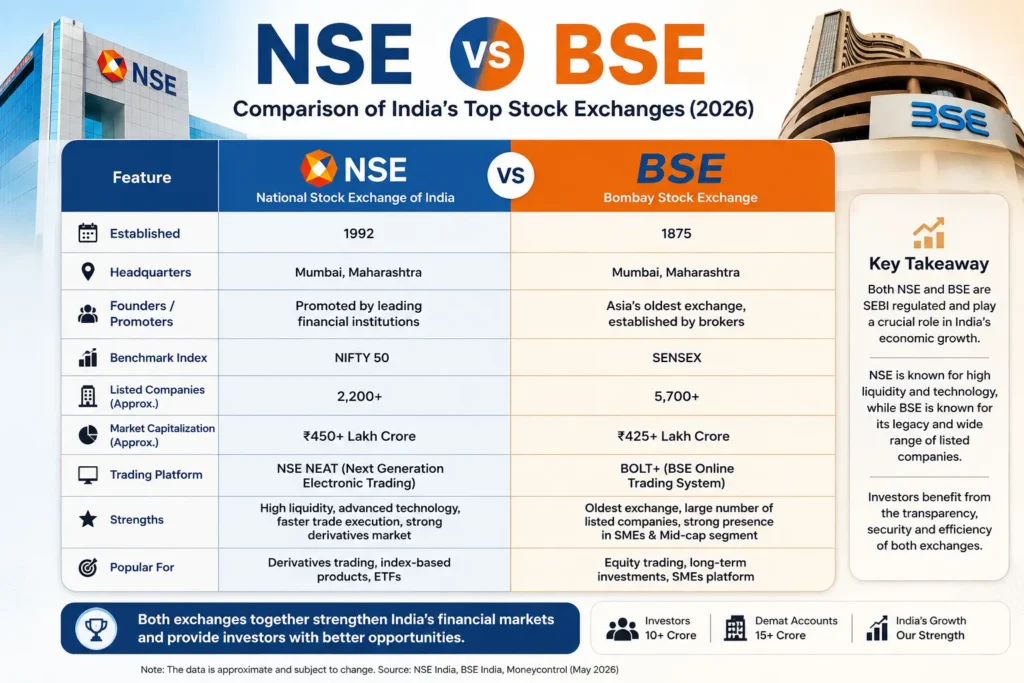
Let me break this down in the simplest way possible.
1. NSE vs BSE — Age and History
BSE is nearly 150 years old. NSE is about 32 years old.
If age was the only thing that mattered, BSE would win every time. But age is just one part of the story.
2. NSE vs BSE — Trading Volume
This is where NSE completely dominates.
NSE handles roughly 90 to 95% of all equity trading in India. On most days, more trades happen on NSE in one hour than BSE handles all day.
For derivatives — futures and options — NSE’s share is even higher. Almost all F&O trading in India happens on NSE.
3. NSE vs BSE — Number of Listed Companies
| Exchange | Listed Companies (2026) |
|---|---|
| BSE | ~5,936 |
| NSE | ~2,781 |
BSE lists more than double the number of companies. Many small-cap and micro-cap stocks are only available on BSE — not on NSE.
4. NSE vs BSE — Benchmark Index
- NSE → Nifty 50 (tracks top 50 companies)
- BSE → Sensex (tracks top 30 companies)
Both track India’s biggest blue-chip companies. So when Nifty goes up, Sensex almost always goes up too. They move together.
5. NSE vs BSE — Derivatives Trading (F&O)
If you want to trade futures and options, use NSE. Period.
Nifty options on NSE are among the most liquid financial instruments in the entire world. BSE has tried to build its derivatives segment but simply cannot match NSE’s liquidity here.
6. NSE vs BSE — Technology
NSE was built on modern technology from day one and has stayed ahead ever since.
BSE has also modernized a lot and runs a solid electronic trading system called BOLT Plus. But in terms of speed and trading infrastructure, NSE has a slight edge.
7. NSE vs BSE — Transaction Costs
BSE charges slightly lower transaction fees than NSE.
But honestly? For most regular investors, this difference is so tiny it barely matters. The bigger costs to watch are brokerage fees, STT (Securities Transaction Tax), and GST — and those apply equally on both exchanges.
NSE vs BSE Quick Comparison Table
| Feature | NSE | BSE |
|---|---|---|
| Founded | 1992 | 1875 |
| Benchmark Index | Nifty 50 | Sensex |
| Listed Companies | ~2,781 | ~5,936 |
| Trading Volume | Very High | Lower |
| F&O Trading | Dominant | Minimal |
| Transaction Cost | Slightly Higher | Slightly Lower |
| Best For | Trading + F&O | Small-cap stocks |
| Regulator | SEBI | SEBI |
Nifty vs Sensex — What is the Difference?
Since we are talking about NSE vs BSE, we also need to quickly explain Nifty and Sensex.
Sensex = BSE’s index. Tracks the top 30 companies. Started in 1986 with a base of 100.
Nifty 50 = NSE’s index. Tracks the top 50 companies across 13 sectors. Started in 1995 with a base of 1,000.
Both track India’s largest companies. Both almost always move in the same direction.
The key difference is scale — 30 companies vs 50 companies. Nifty is more widely followed today for daily trading. Sensex carries more historical significance.
When you hear on the news “markets fell today” — they are usually referring to Nifty and Sensex moving together.
You can read more about Nifty 50 directly on the NSE website- NSE India — Nifty 50
For more reading on how Indian stock markets work, SEBI’s official investor education portal is a great resource- investor.sebi.gov.in
Which One Should You Use — NSE or BSE?
Here is the honest answer — for most people, you do not have to choose.
Most large and mid-cap companies are listed on both exchanges. When you place a buy order on Zerodha, Groww, or any other Indian broker app, the broker automatically routes your order to whichever exchange has the better price. You do not have to do anything.
Use NSE if you are:
- Trading high-volume, liquid stocks
- Doing intraday trading
- Trading futures and options (F&O)
- Investing in Nifty 50 index funds or ETFs
BSE is more relevant if you are:
- Looking for small-cap or micro-cap stocks not listed on NSE
- Interested in niche companies at an early stage
For most beginners — NSE is where you will spend most of your time, even without realizing it.
Are NSE and BSE Safe?
Yes. Both are fully regulated by SEBI — Securities and Exchange Board of India. SEBI is India’s capital market regulator, similar to the SEC in the United States.
Both exchanges follow strict rules on:
- Trading transparency
- Company listing requirements
- Settlement and clearing of trades
- Investor protection
All trades are cleared by separate clearing corporations — NSCCL for NSE and ICCL for BSE — which guarantee settlement even if one party defaults.
In short — both exchanges are safe, well-regulated, and trustworthy.
My Personal Opinion
Honestly, when I first learned about NSE vs BSE, I overcomplicated it in my head.
I kept thinking — do I need to use NSE? Or BSE? What if I pick the wrong one?
The truth is, for everyday investors like you and me, it genuinely does not matter that much for most stocks. Your broker handles it. You just pick a good company at a fair price and invest for the long term.
That said — if you ever want to trade F&O, learn NSE and Nifty inside out. And if you love researching small or emerging companies, BSE is worth exploring.
Both exchanges have made India’s stock market more transparent, more accessible, and more powerful than it was 30 years ago. As an Indian investor, that is something to feel good about.
Also Read
- Market Gap Up Tomorrow May 25: 7 Powerful Reasons Nifty Is Ready to Surge — Crude Crash, Key Levels & More
- 7 Best Travelers Car Insurance Plans in 2026 — Honest Review & Cost Guide
- 7 Hidden Mutual Fund Fees That Are Quietly Reducing Your Returns
- Top 5 Best Indian Stocks to Buy in 2026 for Long-Term Wealth Creation
FAQ
Q1. What is the full form of NSE and BSE?
Ans:- NSE = National Stock Exchange of India. BSE = Bombay Stock Exchange.
Q2. Which is bigger — NSE or BSE?
Ans:- Depends on what you measure. BSE has more listed companies (~5,936). NSE has far higher trading volume and handles nearly all of India’s derivatives trading.
Q3. Can I trade on both NSE and BSE with one account?
Ans:- Yes! Most Indian brokers like Zerodha, Groww, and Upstox give you access to both through a single demat and trading account.
Q4. Is it safe to invest through NSE or BSE?
Ans:- Yes. Both are regulated by SEBI and operate under strong investor protection rules.
Q5. What is the difference between Nifty and Sensex?
Ans:- Nifty 50 is NSE’s benchmark index tracking 50 companies. Sensex is BSE’s index tracking 30 companies. Both track India’s top blue-chip companies and usually move together.
Q6. Which exchange is better for beginners?
Ans:- For beginners investing in large-cap stocks or index funds, NSE is more relevant. Your broker will handle exchange routing automatically.
Q7. Can I buy a stock on NSE and sell on BSE?
Ans:- No. You must buy and sell within the same exchange in the same settlement cycle.
Disclaimer: This article is for educational and informational purposes only. It does not constitute financial or investment advice. Please consult a SEBI-registered financial advisor before making any investment decisions.