
Table of Contents
KPI Green Energy Share Price Target 2026, 2027, 2028, 2029 & 2030
Let me be totally honest with you from the start.
When I first looked at KPI Green Energy share price target, I was genuinely surprised. Here is a small Gujarat-based solar company that most people have never heard of this company and it has delivered 84.8% profit CAGR over the last 5 years. That means the company’s profits have been doubling roughly every year and a half.
That is not normal. That is the kind of number that makes serious investors stop and pay attention.
And then the Q4 FY26 results came out. Profit up 49%. Revenue up 40%. EBITDA up 81%. The stock jumped 11% in a single day.
So yeah — the question everyone is asking now is — what is the KPI Green Energy share price target for 2027, 2028, 2029, and 2030? Is this a stock worth holding for the long term? Or is it too risky?
That is exactly what we are going to figure out in this article. Simply. Honestly. Without the usual jargon.
| Year | Minimum Target | Average Target | Maximum Target |
|---|---|---|---|
| 2026 | ₹500 | ₹580 | ₹650 |
| 2027 | ₹580 | ₹650 | ₹750 |
| 2028 | ₹850 | ₹950 | ₹1,100 |
| 2029 | ₹1,100 | ₹1,300 | ₹1,600 |
| 2030 | ₹1,400 | ₹1,800 | ₹2,400 |
Company Background — What Does KPI Green Energy Actually Do?
Imagine the sun is shining on a huge empty field in Gujarat. KPI Green Energy puts solar panels there. Those panels catch the sunlight and convert it into electricity. Then they sell that electricity to factories, industries, and electricity boards.
That is basically the whole business.
More formally, KPI Green Energy Limited was incorporated in 2008. It is part of the KP Group, which is a Gujarat-based conglomerate. The company develops, builds, owns, manages, and maintains renewable power facilities — mainly solar and wind-solar hybrid power projects.
The Two Main Business Segments:
IPP (Independent Power Producer): The company builds a solar plant, owns it, and sells electricity on a long-term contract basis. This creates stable, recurring revenue — like rental income from a property.
CPP (Captive Power Producer): Here, KPI builds a solar plant specifically for an industrial client’s own use. The client uses the energy directly, saving on their electricity bills.
Think of it like this: IPP is like KPI renting out solar panels and selling the electricity. CPP is like KPI building a customised solar setup for a big factory that wants to power itself.
Revenues come from:
- Solar project development (EPC services)
- Power generation (electricity sales)
- Hybrid renewable projects
- Battery Energy Storage Systems (BESS) — the new one
The company’s website shows a 6.26 GW total portfolio and 3.59 GW cumulative power evacuation. Their group ambition is to reach 10 GW by 2030. That is massive.
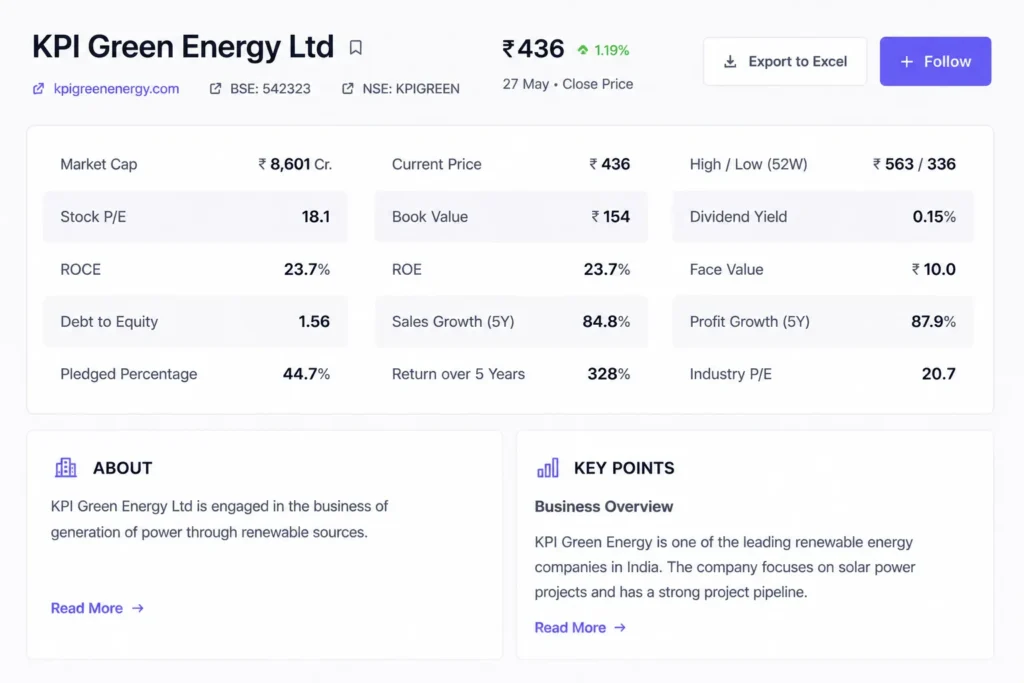
Current Share Price and Key Data From Screener
Based on the Screener.in data as of May 27, 2026, here is exactly what the numbers look like:
| Metric | Value |
|---|---|
| Current Price | ₹436 |
| 52-Week High / Low | ₹563 / ₹336 |
| Market Cap | ₹8,601 Crore |
| Stock P/E | 18.1 |
| Book Value | ₹154 |
| Dividend Yield | 0.15% |
| ROCE | 13.8% |
| ROE | 17.4% |
| Face Value | ₹5.00 |
| Listed On | BSE: 542323 / NSE: KPIGREEN |
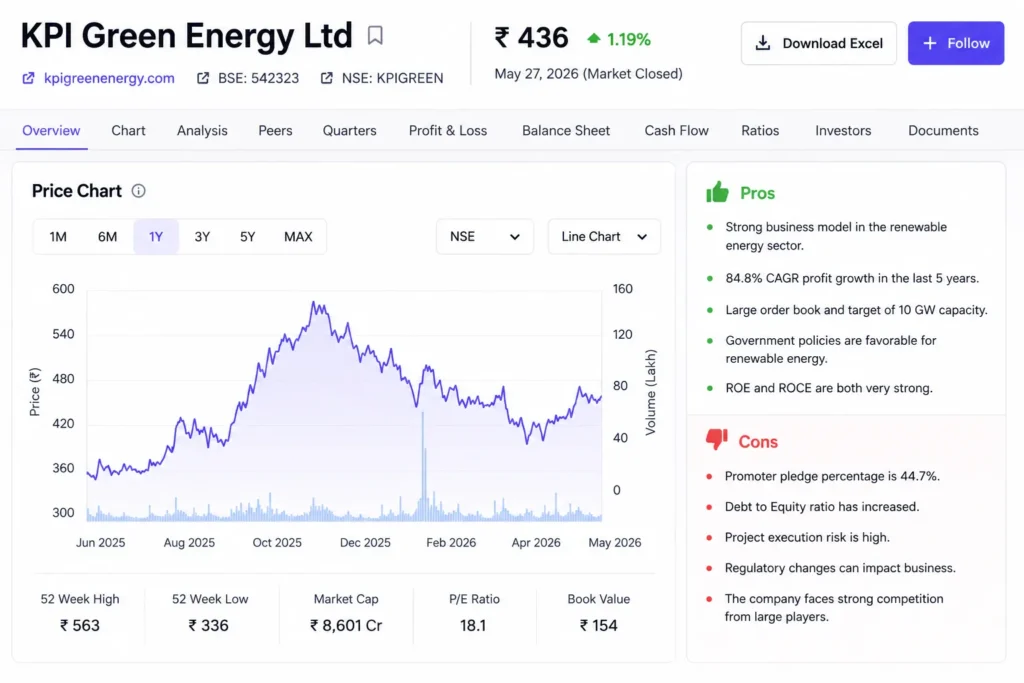
Right now, the stock is trading at ₹436 — which is well below its 52-week high of ₹563 but comfortably above its 52-week low of ₹336.
The P/E of 18.1 is actually quite reasonable for a high-growth renewable energy company. Most comparable companies trade at P/E of 30-50. This is one reason why some analysts have a buy rating on this stock with targets up to ₹562.
The ROE of 17.4% is healthy. It means the company is generating ₹17.4 in profit for every ₹100 of shareholder equity — a decent return on capital.
KPI Green Energy Share Q4 FY26 Results
This is where it gets really interesting. The Q4 FY26 results of KPI Green Energy were genuinely impressive — not just good, but actually strong.
Here are the headline numbers:
| Metric | Q4 FY26 | Q4 FY25 | Growth |
|---|---|---|---|
| Revenue | ₹795.8 Crore | ~₹569 Crore | +40% YoY |
| PAT (Net Profit) | ₹155.5 Crore | ₹99.1 Crore | +49% YoY |
| EBITDA | ₹291.3 Crore | ~₹161 Crore | +81% YoY |
| EBITDA Margin | 36.6% | ~28% | Expanded |
For the full year FY26:
- Revenue growth: +55.3% YoY
- EBITDA growth: +70% YoY
- PAT growth: +49% YoY
When these results came out, the stock jumped 11% in a single trading day — touching ₹493.8 at one point.
One important analyst note from Groww: A buy rating has been maintained on KPI Green Energy with a target price of ₹562, valuing it at 18x FY27E EPS of ₹31.2. That means analysts expect EPS to grow from the current level to ₹31.2 in FY27.
The only concern from the results: long-term debt rose sharply. This is something every investor needs to keep an eye on.
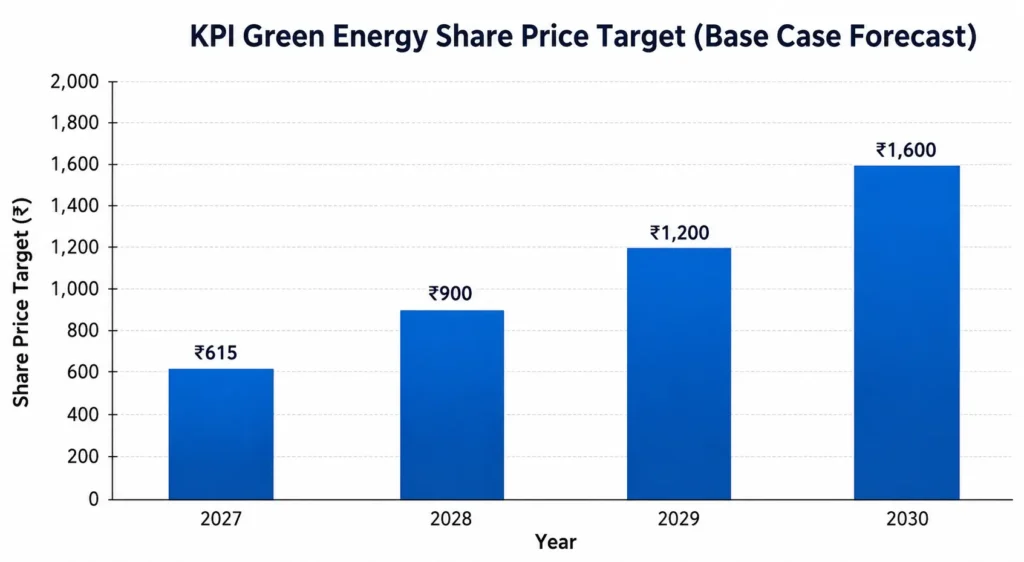
KPI Green Energy Share Price Target 2027
Alright, let us get to the part everyone is actually here for. What is the KPI Green Energy share price target for 2027?
Based on:
- Current analyst consensus (buy at 18x FY27E EPS of ₹31.2)
- Revenue growth trajectory of 40-55%
- Company’s target of 5 GW portfolio by FY27-28
- Ongoing NTPC, GUVNL, and Coal India project executions
KPI Green Energy Share Price Target 2027:
| Scenario | Target Price |
|---|---|
| Conservative (if growth slows) | ₹520 – ₹560 |
| Base Case (current growth pace) | ₹580 – ₹650 |
| Optimistic (if new orders accelerate) | ₹700 – ₹750 |
My honest opinion: The ₹562 analyst target is for near-term. If the company executes its 5 GW portfolio plan and EBITDA continues growing at 50-70%, the stock reaching ₹600-₹650 by end of 2027 is a realistic base case — not a fantasy.
Example: Imagine you have ₹1 lakh invested at today’s price of ₹436. If the stock reaches ₹650 by 2027, that becomes ₹1.49 lakh — a 49% return in roughly 18 months. Not bad at all.
KPI Green Energy Share Price Target 2028
For 2028, the story gets even more interesting.
By 2028, if KPI Green Energy successfully:
- Executes the Coal India 405 MWp Khavda project
- Completes the SJVN 246 MWp project
- Scales up its BESS (Battery Storage) business following the GUVNL 120 MW win
- Continues growing CPP vertical revenue
Then the earnings and cash flows by FY28 should be significantly higher than today.
KPI Green Energy Share Price Target 2028:
| Scenario | Target Price |
|---|---|
| Conservative | ₹700 – ₹800 |
| Base Case | ₹850 – ₹950 |
| Optimistic | ₹1,000 – ₹1,100 |
At 18-20x FY28E earnings — assuming EPS grows to ₹45-₹50 by FY28 — a price range of ₹810-₹1,000 is plausible.
Simple example: If you put ₹50,000 in KPI Green Energy today at ₹436 and the stock reaches ₹900 by 2028, your investment becomes ₹1,03,211. That is roughly doubling your money in 2 years.
But remember — this only happens if the company actually delivers on its execution. Debt management is the key risk to watch between now and 2028.
KPI Green Energy Share Price Target 2029
By 2029, KPI Green Energy’s expansion into green hydrogen, international markets, and full battery storage rollout should start reflecting in the numbers.
India’s renewable energy capacity is targeted to reach 500 GW by 2030 under the government’s national energy mission. Companies like KPI Green Energy are directly in the path of this massive tailwind.
KPI Green Energy Share Price Target 2029:
| Scenario | Target Price |
|---|---|
| Conservative | ₹900 – ₹1,050 |
| Base Case | ₹1,100 – ₹1,300 |
| Optimistic | ₹1,400 – ₹1,600 |
If the 10 GW group portfolio target is on track by 2029, the market re-rating could be significant — especially if international investors take a bigger position in the stock.
KPI Green Energy Share Price Target 2030
The 2030 target is where things get really exciting — but also where uncertainty is highest.
By 2030, if India achieves its 500 GW renewable energy target (and all signs point toward significant progress in that direction), the entire renewable sector will be trading at premium valuations. KPI Green Energy, with its 10 GW group ambition and expanding BESS and green hydrogen pipeline, could be one of the marquee mid-to-large cap renewable stocks.
KPI Green Energy Share Price Target 2030:
| Scenario | Target Price |
|---|---|
| Conservative | ₹1,100 – ₹1,300 |
| Base Case | ₹1,400 – ₹1,800 |
| Optimistic | ₹2,000 – ₹2,400 |
One external research algorithm-based target suggests ₹2,371 by 2030. That is aggressive but not impossible if the company grows at current rates and debt stays under control.
Summary of All Targets:
| Year | Conservative | Base Case | Optimistic |
|---|---|---|---|
| 2027 | ₹520 – ₹560 | ₹580 – ₹650 | ₹700 – ₹750 |
| 2028 | ₹700 – ₹800 | ₹850 – ₹950 | ₹1,000 – ₹1,100 |
| 2029 | ₹900 – ₹1,050 | ₹1,100 – ₹1,300 | ₹1,400 – ₹1,600 |
| 2030 | ₹1,100 – ₹1,300 | ₹1,400 – ₹1,800 | ₹2,000 – ₹2,400 |
Pros of KPI Green Energy Share
From both the Screener.in data and the Q4 FY26 results, here are the genuine positives:
84.8% CAGR Profit Growth Over 5 Years This is the number that every growth investor dreams about. It means the company has been nearly doubling its profits every 18 months over the past 5 years. That is exceptional.
Company Is Expected to Give Good Quarter Going Forward Screener’s own machine-generated pros note says the company is expected to deliver a good quarter — which means the momentum is likely to continue.
Strong Order Book Projects from NTPC REL (₹621 crore, 500 MW in Rajasthan), GUVNL (120 MW battery storage), Coal India (405 MWp Khavda), and SJVN (246 MWp) give excellent revenue visibility for the next 2-3 years.
Reasonable Valuation A P/E of 18.1 for a company growing profits at 49% per year is genuinely cheap. Most renewable energy companies with similar growth profiles trade at P/E of 30-50.
Government Tailwind India’s push for 500 GW renewable capacity by 2030 is the biggest single driver for this company. Every new renewable energy policy, subsidy, or tender that the government launches is directly positive for KPI Green Energy.
Diversification Into BESS The battery energy storage win from GUVNL shows the company is not just a solar player anymore. BESS is the next big thing in India’s energy transition — and KPI is already there.
Cons and Risks KPI Green Energy Share
I always believe in being honest about risks. Here is what the Screener data and Q4 results show as concerns:
Promoters Have Pledged 44.7% of Their Holding This is a big red flag that many retail investors miss. When promoters pledge shares as collateral for loans, it creates a risk — if the stock falls sharply, lenders can sell the pledged shares in the market, which pushes the stock even lower. 44.7% pledging is high.
Promoter Holding Has Decreased Over Last 3 Years: -5.32% Promoters slowly reducing their stake is not a great sign. It could mean they are taking profits — or it could be due to pledging-related selling. Either way, investors should track this number quarterly.
Company Might Be Capitalising Interest Costs This is a more technical concern. If the company is capitalising interest costs instead of expensing them, it can make profits look higher in the short term while the actual financial burden builds. This is something to verify in the detailed annual report.
Long-Term Debt Rose Sharply in Q4 FY26 Renewable energy projects are capital-intensive — they require large upfront investment. KPI has taken on more debt to fund its expansion. This is not necessarily bad, but it needs to be monitored closely. High debt + rising interest rates = potential earnings pressure.
Project Execution Risk The company’s targets and price performance depend entirely on executing massive projects on time and on budget. Delays in grid connectivity (Gujarat grid readiness is specifically mentioned as a risk), land acquisition issues, or supply chain problems can push back timelines significantly.
Future Plans — Where Is This Company Going?
KPI Green Energy is not sitting still. The management has laid out an ambitious roadmap:
10 GW Group Portfolio by 2030 This is the headline target. Going from 6.26 GW today to 10 GW by 2030 means adding about 3.74 GW more over the next 4 years. That is roughly 1 GW of new capacity every year — which is very aggressive for a company of this size.
5 GW Portfolio by FY27-28 A more near-term milestone. The company needs to execute its current order book efficiently to hit this target.
Battery Energy Storage Systems (BESS) The GUVNL deal for 120 MW / 240 MWh standalone BESS is just the beginning. As India’s grid becomes more dependent on renewable energy, the need for battery storage grows exponentially. This is a high-margin, high-growth business that KPI is entering at exactly the right time.
Green Hydrogen Very early stage but a stated future opportunity. Green hydrogen is produced using renewable electricity and is expected to be a key fuel for heavy industry and transportation in India by 2030-2035.
International Market Expansion Management has mentioned interest in international markets. Details are still vague, but this could be a significant long-term value driver if executed well.
For more on India’s renewable energy policies and government targets, visit https://mnre.gov.in the Ministry of New and Renewable Energy’s official website.
For tracking KPI Green Energy’s latest quarterly results and financial ratios, check https://www.screener.in/company/KPIGREEN/consolidated/ .
Should You Invest in KPI Green Energy?
Alright — the big question. Should you actually put your money into this stock?
Here is my honest, plain-language view:
If you are a long-term investor (5+ year horizon): KPI Green Energy has the ingredients of a strong growth story. Renewable energy sector tailwind, strong execution track record, diversification into BESS, reasonable valuation. If you can tolerate volatility and high promoter pledging risk — this is a stock worth researching seriously.
If you are looking for a quick trade: Probably not ideal. The stock has already jumped 11% on Q4 results. The easy money may already be made in the short term.
If debt levels or promoter pledging make you nervous: That is a completely valid concern. High promoter pledging is a genuine risk in any stock. You may want to wait for pledging levels to come down before investing.
My simple example for new investors: Think of investing in KPI Green Energy like planting a mango tree. You plant it (invest today at ₹436). For the first 2-3 years, you water it patiently (you don’t panic when the stock falls). By 2030, if the tree grows well, you get a lot of mangoes (returns). But if there is a drought (bad policy changes, high debt problems), the tree may not grow as expected.
Key things to monitor every quarter:
- Is promoter pledging going up or down?
- Is the order book growing?
- Is debt being managed responsibly?
- Are new projects being completed on time?
Also Read (Internal Links)
- EPFO UPI Withdrawal 2026: 5 Powerful Steps to Instantly Get Your PF Money Right Now
- What is Stock Market? Complete Beginner Guide for Indians in 2026
- Rajnandini Fashion India IPO Could Give Big Listing Gains? Full Analysis
- ACKO Life Insurance Policy Details: Plans, Benefits, Policy Download & Claim Process (2026)
- Top 5 Best Indian Stocks to Buy in 2026 for Long-Term Wealth Creation
FAQ — KPI Green Energy Share Price Target
Q1. What is the KPI Green Energy share price target for 2027?
Ans:- The KPI Green Energy share price target for 2027 is expected to be around ₹580 to ₹650 in normal market conditions. If the company continues strong growth and executes projects successfully, the stock may reach ₹700 to ₹750.
Q2. What is the KPI Green Energy share price target for 2028?
Ans:- The KPI Green Energy share price target for 2028 is estimated between ₹850 and ₹950. If the company keeps growing fast in solar and battery projects, the stock may even cross ₹1,000.
Q3. What is the KPI Green Energy share price target for 2030?
Ans:- The KPI Green Energy share price target for 2030 could range from ₹1,100 to ₹1,800 in the base scenario. In a highly positive growth case, the stock may reach ₹2,400 by 2030.
Q4. Is KPI Green Energy a good long-term investment?
Ans:- KPI Green Energy looks strong for long-term investment because of its fast profit growth and renewable energy business expansion. However, risks like promoter pledging and rising debt should also be considered before investing.
Q5. What is the current KPI Green Energy share price?
Ans:- As of May 2026, KPI Green Energy share price is around ₹436 on NSE and BSE. The stock’s 52-week high is ₹563 and low is ₹336.
Q6. What is KPI Green Energy’s 10 GW target?
Ans:- KPI Green Energy plans to achieve a total 10 GW renewable energy portfolio by 2030. The company is also targeting 5 GW capacity by FY27-28.
Q7. What are the main risks in KPI Green Energy share price target projections?
Ans:- The main risks are high promoter pledging, increasing debt, project delays, government policy changes, and competition in the renewable energy sector.
Q8. What is KPI Green Energy’s dividend yield?
Ans:- KPI Green Energy has a very low dividend yield of around 0.15%. This stock is mainly considered a growth stock, not a dividend income stock.
Disclaimer: This article is for educational and informational purposes only. Share price targets mentioned are based on publicly available analyst reports, algorithmic forecasts, and author opinion. They do not constitute investment advice. Stock markets are subject to risks. Please consult a SEBI-registered investment advisor before making any investment decision. Past performance is not a guarantee of future returns.