
Table of Contents
What Is Sensex and Nifty — Why Do These Two Words Rule Indian Finance?
What is Sensex and Nifty — this is one of the most Googled financial questions in India every single day. And honestly, that makes complete sense.
Every morning, the news anchor says “Sensex opens 300 points higher.” Every evening on WhatsApp, someone forwards “Nifty crosses 25,000 today.” People in offices, chai shops, auto stands — everyone talks about whether the market went up or down.
But here is the real question nobody asks out loud: do most people actually understand what these numbers mean?
Most do not. And that is completely fine — because nobody ever explained it properly.
Let me fix that today.
In this guide I will explain what is Sensex and Nifty in the simplest possible way with real examples, real numbers and zero jargon. By the time you finish reading this, you will understand exactly what these numbers are, where they come from and why they matter for your money.
Let us start from the very beginning.
What Is an Index? Understand This First
Before I explain what Sensex and Nifty are you need to understand what a stock market index is.
Here is the problem that a stock market index solves.
India has than 5,000 companies listed on its stock market. Every day the share prices of all these companies change. Some go up by 3 percent some fall by 5 percent and some do not change. If someone asks you “how did the stock market do today”. You cannot look at the prices of 5,000 stocks. Give a meaningful answer.
You need one number that tells you the direction of the stock market.
That is what a stock market index does.
Think of a stock market index like your school report card.
Imagine you took 20 tests throughout the year. Maths, science, English, history. Of looking at all 20 scores your teacher gives you one final percentage that tells you how you did overall. That single number tells you how you did for the year.
A stock market index does the thing for the stock market. It picks a group of companies and tracks their performance as one number. When that number goes up. The stock market is doing well. When it falls. Something is worrying the investors in the stock market.
Sensex and Nifty are the two important stock market indices in India. They do this job. They tell you what is happening to the biggest companies, in India in one single number.
Now let us understand each of the stock market indices, Sensex and Nifty individually.
What Is Sensex?
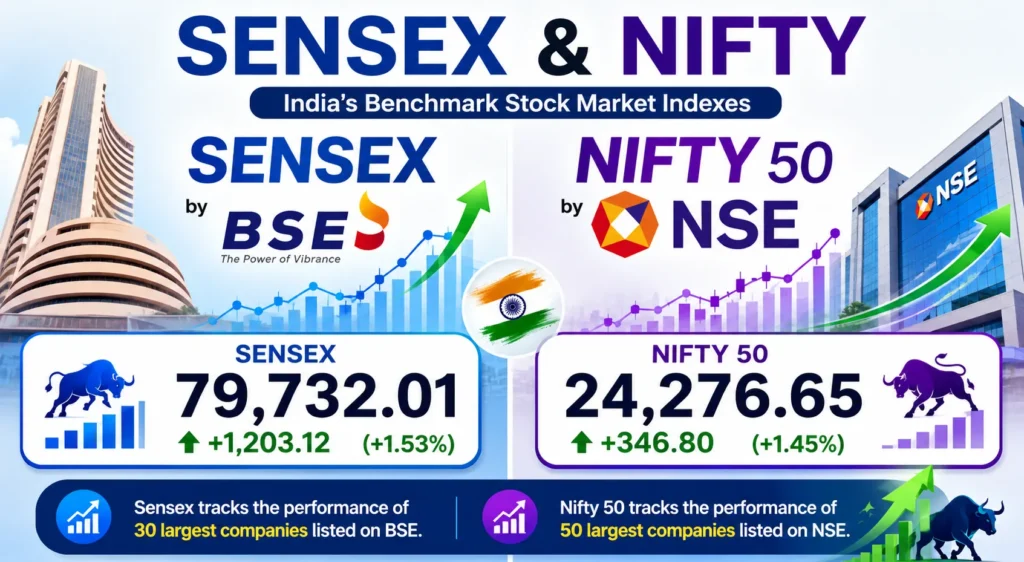
Sensex is the main stock market index of the Bombay Stock Exchange (BSE). The name “Sensex” comes from combining two words — Sensitive + Index.
It is also officially called the S&P BSE Sensex.
Sensex tracks the performance of India’s top 30 largest and most actively traded companies listed on BSE. These 30 companies represent the overall health of the Indian economy across multiple sectors.
Key Facts About Sensex:
| Detail | Information |
|---|---|
| Full Name | S&P BSE Sensex |
| Exchange | Bombay Stock Exchange (BSE) |
| No. of Companies | 30 |
| Base Year | 1978–79 |
| Base Value | 100 |
| Created | 1986 |
The BSE Sensex was officially launched on January 2, 1986, with a base value of just 100. That number represented the combined market value of 30 leading Indian companies at the time.
Today, the Sensex trades around the 80,000 mark.
Think about that for a moment. An index that started at 100 has grown nearly 800 times over the decades. While the companies inside the index have changed over the years, the journey of the Sensex tells a powerful story about India’s economic progress, business growth, and wealth creation.
From a developing economy in the 1980s to one of the world’s fastest-growing major economies today, the rise of the Sensex reflects how Indian businesses have expanded, innovated, and created value for investors.
Some well-known companies currently in Sensex:
- Reliance Industries
- HDFC Bank
- Infosys
- TCS
- ICICI Bank
- Larsen & Toubro
- Bajaj Finance
- Hindustan Unilever
- State Bank of India
- Kotak Mahindra Bank
The exact 30 companies change periodically as BSE reviews which ones deserve their spot based on size, trading volume, and sector importance.
What does it mean when Sensex rises 500 points?
When people say the Sensex has risen by 500 points, it means the overall value of the 30 companies that make up the index has increased.
A rise like this usually happens when investors are buying shares because they feel optimistic about the economy, corporate earnings, government policies, or future business growth.
For example, if major companies such as banks, IT firms, and industrial giants see strong buying interest, their share prices move higher. Since these companies are part of the Sensex, the index also rises. However, a 500-point move doesn’t mean every company in the market went up. It simply shows that, on balance, the companies that make up the Sensex gained value and helped push the index higher.
What does it mean when Sensex falls 800 points?
When the Sensex falls by 800 points, it means the combined value of the 30 companies in the index has dropped significantly during the trading session.
This usually happens when investors become worried and start selling shares. The reasons can vary — weak economic data, rising inflation, global market declines, geopolitical tensions, disappointing corporate earnings, or unexpected events that create uncertainty.
As selling pressure increases, share prices of major companies fall. Since these companies make up the Sensex, the index also moves lower.
It’s important to remember that an 800-point fall doesn’t mean every company in the stock market lost value. It simply indicates that the overall performance of the companies within the Sensex was negative enough to pull the index down.
What Is Nifty 50?
Nifty 50 is the main stock market index of the National Stock Exchange (NSE). The name “Nifty” comes from combining two words — National + Fifty.
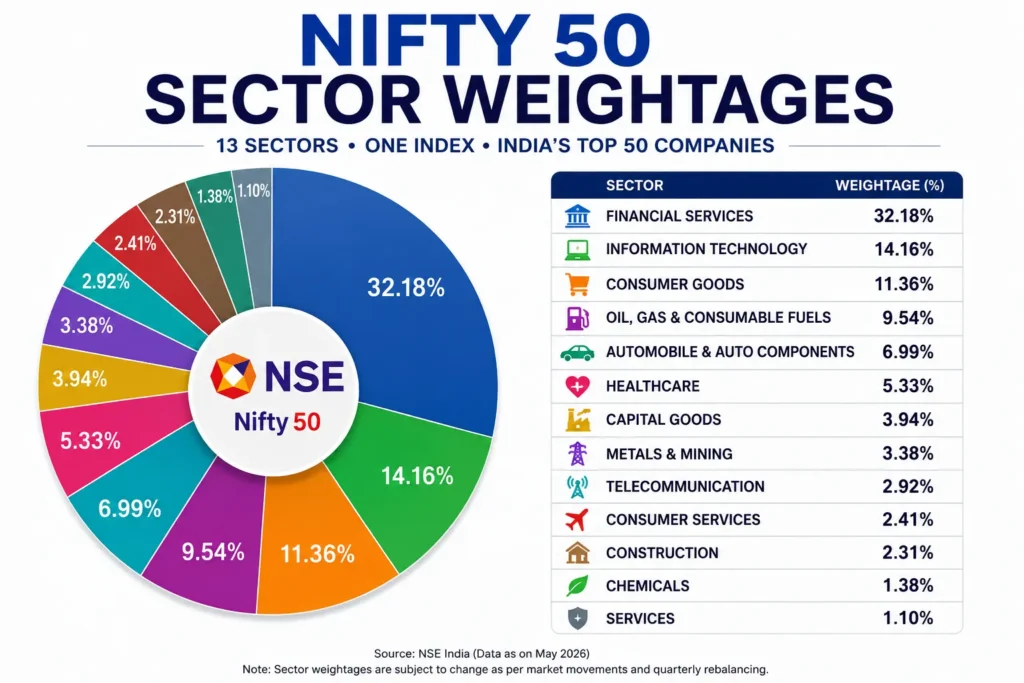
It tracks the performance of India’s top 50 largest and most liquid companies across 13 different sectors of the economy.
Key Facts About Nifty 50:
| Detail | Information |
|---|---|
| Full Name | Nifty 50 (also called CNX Nifty) |
| Exchange | National Stock Exchange (NSE) |
| No. of Companies | 50 |
| Base Date | November 3, 1995 |
| Base Value | 1,000 |
| Managed By | NSE Indices Limited |
The Nifty 50 was launched in November 1995 with a base value of 1,000. Today, it trades above 25,000.
The combined value of India’s 50 largest and most influential companies has grown more than 25 times over the past three decades. That’s a remarkable reflection of how far Indian businesses and the economy have come.
To put that into perspective, if an investor had put ₹1 lakh into a Nifty 50 index fund in 1995 and simply stayed invested, that investment would be worth around ₹25 lakh today, even before considering dividends and other benefits.
That’s one of the biggest lessons of long-term investing. Wealth isn’t always created by constantly buying and selling stocks. Often, it’s created by choosing quality businesses, staying patient, and giving your money enough time to grow.
The story of the Nifty 50 shows that time in the market can be far more powerful than trying to time the market.
The 13 sectors represented in Nifty 50:
- Financial Services (banks, NBFCs, insurance)
- Information Technology
- Oil, Gas and Energy
- Consumer Goods (FMCG)
- Automobiles
- Healthcare and Pharma
- Metals and Mining
- Construction and Real Estate
- Cement and Building Materials
- Telecom
- Power and Utilities
- Chemicals
- Media and Entertainment
Some major companies currently in Nifty 50:
- Reliance Industries
- HDFC Bank
- Infosys
- TCS
- ICICI Bank
- Axis Bank
- Sun Pharma
- Tata Motors
- NTPC
- Power Grid Corporation
NSE reviews and updates the Nifty 50 composition every 6 months — in March and September replacing companies that no longer meet the criteria.
What Are Nifty and Sensex Together – How Are They Related?
People often ask what are Nifty and Sensex and NIfty and Sensex are they the same thing?
They are not the same but they are very closely related.
Here is the simple way to think about it:
Sensex = BSE’s report card for India’s top 30 companies
Nifty = NSE’s report card for India’s top 50 companies
Both indices cover India’s biggest, most well-known companies. In fact, most of the companies in Sensex’s 30 are also included in Nifty’s 50. So both indices track largely the same set of large companies.
This is why Sensex and Nifty almost always move in the same direction on the same day. When Sensex goes up 400 points, Nifty almost certainly goes up too usually by a similar percentage. It would be very unusual for one to go up while the other falls.
The two indices exist separately because BSE and NSE are two separate stock exchanges and each has its own benchmark index. But for everyday investors, they tell you the same basic story about India’s stock market.
How Is Sensex Calculated?
Both Sensex and Nifty use the same calculation method called free-float market capitalisation.
Let me break this down with a simple example.
Step 1 — Market Capitalisation
Market capitalisation = Total number of shares × Current share price
Example: A company has 10 crore shares. Each share costs ₹500. Market cap = 10 crore × ₹500 = ₹5,000 crore
Step 2 — Free-Float Market Capitalisation
Not all shares trade in the open market. Promoters, the government, and large shareholders hold shares that they never sell. Free-float means only the shares available for public trading.
Same example: That company has 10 crore total shares. But the promoter holds 40% and never trades them. Only 60% — 6 crore shares — are in the open market.
Free-float market cap = 6 crore × ₹500 = ₹3,000 crore
Step 3 — Why Does This Matter?
Companies with bigger free-float market caps carry more weight in the index. This means Reliance Industries — one of India’s most valuable companies — moves the Sensex much more than a smaller company in the index.
That is why you often hear “Reliance dragged the index lower” or “HDFC Bank’s rally pushed Nifty higher.”
The Formula:
Index Value = (Current Free-Float Market Cap of all companies ÷ Base Market Cap) × Base Value
For Sensex: Base value = 100 For Nifty: Base value = 1,000
How Is Nifty 50 Calculated?
Nifty 50 uses the exact same free-float market capitalisation method as Sensex.
NSE’s index management team calculates this value in real time throughout every trading day. As stock prices change every second between 9:15 AM and 3:30 PM, the Nifty 50 value updates continuously.
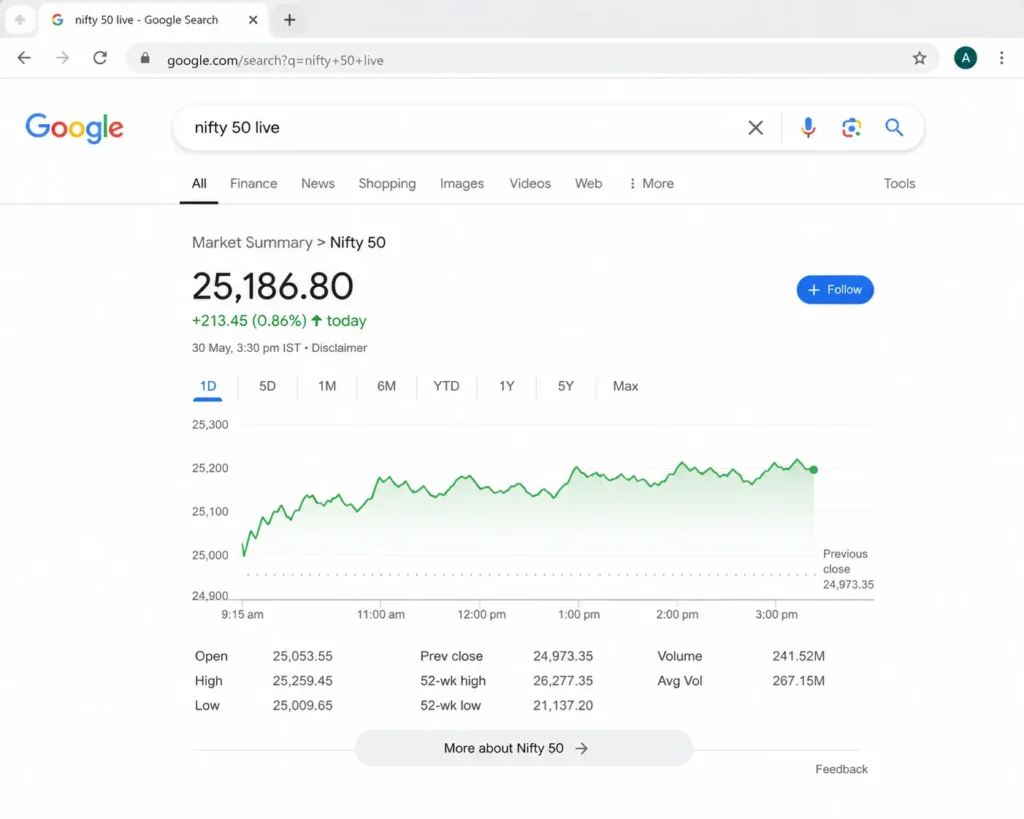
You can watch this live value change on any broker app, on NSE’s website, or simply by searching “Nifty 50” on Google.
The key practical point: because bigger companies have more weight in the index, not every stock move affects Nifty equally. A 5% move in Reliance Industries affects Nifty far more than a 5% move in a smaller Nifty constituent.
What Is the Difference Between Sensex and Nifty 50?
Here is a clean comparison so you can see exactly what is the difference between Sensex and Nifty 50:
| Feature | Sensex | Nifty 50 |
|---|---|---|
| Exchange | BSE (Bombay) | NSE (National) |
| No. of Companies | 30 | 50 |
| Base Year | 1978–79 | November 1995 |
| Base Value | 100 | 1,000 |
| Sectors Covered | Multiple | 13 clearly defined |
| Used For | Historical reference, media | Active trading, F&O, benchmarking |
| Index Funds | Yes | Yes — more widely available |
| Review Frequency | Periodic | Every 6 months (March, September) |
The most important practical difference:
Nifty 50 is more widely used today for active investing, index funds, ETFs, and derivatives trading. When someone says “the market is at 25,000” they almost always mean the Nifty 50 value.
Sensex is more commonly mentioned in traditional media TV news, newspapers and has deeper historical significance since it started in 1986.
For most retail investors in 2026, Nifty 50 is the number to track.
What Moves Sensex and Nifty Up or Down?
This is one of the most important things to understand as an investor. Eight major factors move Sensex and Nifty every single day.
1. Company Quarterly Results
Every three months, listed companies report their earnings. Strong profits from Nifty companies push the index higher. Disappointing results bring it down.
Example: When TCS reports 15% profit growth, its share price jumps — and since TCS is a heavyweight in both Sensex and Nifty, the indices move higher too.
2. RBI Interest Rate Decisions
When the RBI cuts interest rates loans become cheaper, businesses borrow and invest more, profits rise. Markets love rate cuts. When RBI raises rates borrowing costs rise, business slows, and markets fall.
3. Union Budget Announcements
Budget day is one of the biggest single-day events for Indian markets every year. Tax changes, infrastructure spending plans, and sector-specific policies cause sharp moves in the indices.
4. Global Market Movements
When US markets crash at night, Indian markets almost always open lower the next morning. India does not exist in a bubble global money flows connect our markets to every major economy in the world.
Example: When the US Federal Reserve raised interest rates aggressively in 2022, Nifty fell from 18,600 to 15,800 — even though Indian economic data was perfectly healthy.
5. FII and DII Activity
FIIs (Foreign Institutional Investors) — large global funds — bring billions into Indian markets when they see opportunity. When they sell and leave, markets fall sharply. DII (Domestic Institutional Investors — Indian mutual funds, insurance companies) buying often cushions these FII exits.
6. Inflation Data
High inflation means the RBI might raise rates which markets dislike. Low and controlled inflation gives the RBI room to cut rates which markets love.
7. Crude Oil Prices
India imports about 85% of its oil. When global crude prices rise sharply import costs rise, the rupee weakens, inflation increases, and markets fall. Falling oil prices have the opposite, positive effect.
Example: In 2022, crude oil crossing $120 per barrel was one of the reasons Nifty corrected 15% from its peak.
8. Rupee vs Dollar
When the rupee weakens against the dollar, foreign investors get lower returns in their home currency so they often sell Indian stocks and pull money out. A stronger rupee generally supports higher indices.
What Is Bank Nifty and Nifty 50 — Are They the Same?
Many people confuse these two, so let me clear this up clearly.
What is Bank Nifty and Nifty 50 — they are two completely different indices.
Nifty 50 covers India’s top 50 companies across 13 sectors — including banks, IT, energy, FMCG, pharma, and more.
Bank Nifty (officially called Nifty Bank) covers only the top 12 banking stocks on NSE. It is a sectoral index — tracking only the banking sector, not the whole market.
Bank Nifty is extremely popular with short-term traders and options traders because it is highly liquid and volatile. It moves more sharply than Nifty 50 on days when banking news dominates.
Other important Nifty sub-indices you will hear about:
| Index | What It Tracks |
|---|---|
| Nifty Bank | Top 12 banking stocks |
| Nifty IT | Top IT companies (TCS, Infosys, Wipro, HCL) |
| Nifty Midcap 100 | 100 mid-sized companies |
| Nifty Smallcap 100 | 100 smaller companies |
| Nifty Next 50 | 50 companies just below Nifty 50 in size |
| Nifty 500 | Broader index of top 500 companies |
For beginners — only track Nifty 50 and occasionally check Nifty Bank. The rest are for more experienced investors.
What Is Sensex and Nifty Today — Where to Check Live?
You can check the live values of what is Sensex and Nifty today from any of these free sources:
Most popular method — just Google it: Type “Nifty 50” or “Sensex” in Google search. The live value appears right in the search results instantly no clicking required.
Official sources:
- NSE India: https://www.nseindia.com
- BSE India: https://www.bseindia.com
Financial data platforms:
- Moneycontrol: https://www.moneycontrol.com
- Economic Times Markets
- Your broker app (Zerodha, Groww, Upstox)
Why Sensex and Nifty Matter for Your Investments
Even if you never trade a single stock, what is Sensex and Nifty directly affects your money in these very real ways:
Your Mutual Fund SIP
If you invest in equity mutual funds through SIP, your fund’s performance is measured against Nifty 50 or Sensex. When the index does well, your fund’s NAV generally rises. When the index falls, your NAV falls too but stay invested, because it always recovered historically.
Your Nifty 50 Index Fund
If you invest in a Nifty 50 index fund or ETF, your investment literally mirrors the Nifty 50 movement. Nifty up 12% this year = your index fund up approximately 12% too. This is the simplest and most cost-efficient way to invest in India’s growth.
Example: ₹5,000 per month SIP in a Nifty 50 index fund started in January 2016 would have grown to approximately ₹15.8 lakh by May 2026 on a total investment of just ₹6 lakh.
Your EPF and NPS
A portion of your Employee Provident Fund and National Pension System contributions go into equity which means they are linked to Nifty 50 index funds.
Your Overall Financial Decision Making
Understanding whether the market is in a bull phase (rising trend) or bear phase (falling trend) helps you decide when to invest more aggressively, when to be patient, and when to simply hold steady and not panic.
Historical Performance
Here is the most inspiring part of this whole story.
When Sensex started in 1986 it was around 500-600 points. Today it is above 80,000. That is a 130+ times increase in 38 years.
Nifty 50 started at 1,000 in November 1995. Today it is above 25,000. That is a 25 times increase in 29 years.
These numbers survived everything:
- The dot-com crash of 2000 (Sensex fell 55%)
- The global financial crisis of 2008 (Sensex crashed from 21,000 to 8,000)
- The COVID crash of March 2020 (Nifty fell 38% in just 5 weeks)
- Multiple geopolitical crises, oil shocks, currency devaluations
And yet after every single crash the market fully recovered and went higher.
This teaches every investor in India one golden lesson:
The market falls. The market recovers. Patient investors who stay invested through the downturns get richly rewarded.
Also Read (Internal Links)
- Top 10 Mutual Funds for SIP to Invest in 2026 — Brilliant Picks
- 7 Hidden Mutual Fund Fees That Are Secretly Destroying Your SIP Returns
- KPI Green Energy Share Price Target 2027 to 2030 — Full Analysis
- LIC Share Price Target 2027 to 2030 — Complete Analysis
- Merritronix IPO 2026: Complete Review, GMP, Price Band, Dates & Should You Apply?
FAQ
Q1. What is Sensex and Nifty?
Ans:- Sensex is a number that tracks the performance of India’s top 30 companies on the Bombay Stock Exchange (BSE). Nifty is a number that tracks India’s top 50 companies on the National Stock Exchange (NSE). Both numbers go up when the overall Indian stock market does well and fall when it does poorly. They are India’s most important stock market indices — think of them as report cards for the entire Indian stock market.
Q2. What are Nifty and Sensex are they the same?
Ans:- No, what are Nifty and Sensex are two different but closely related indices. Sensex belongs to BSE and tracks 30 companies. Nifty 50 belongs to NSE and tracks 50 companies across 13 sectors. Both cover India’s largest companies and almost always move in the same direction. For everyday investors, Nifty 50 is more widely used today.
Q3. What is Nifty 50 and Sensex today — how to check?
Ans:- You can check what is Nifty 50 and Sensex today by simply searching “Nifty 50” or “Sensex” on Google — the live value appears instantly in the search results. You can also check on nseindia.com, bseindia.com, Moneycontrol, or any broker app like Zerodha or Groww.
Q4. What is the difference between Sensex and Nifty?
Ans:- Sensex has 30 companies from BSE, base value of 100 (1978-79). Nifty 50 has 50 companies from NSE across 13 sectors, base value of 1,000 (1995). Nifty is more widely used today for mutual fund benchmarking, ETFs, index funds, and derivatives trading. Sensex is more prominent in traditional media and news.
Q5. What is Bank Nifty and Nifty are they the same?
Ans:- No. What is Bank Nifty and Nifty are two separate things. Nifty 50 covers India’s top 50 companies across all sectors of the economy. Bank Nifty (officially Nifty Bank) tracks only the top 12 banking stocks on NSE. Bank Nifty is much more volatile than Nifty 50 and is heavily used by options traders.
Q6. What are NSE Sensex and NSE Nifty?
Ans:- NSE is the National Stock Exchange. Nifty 50 is NSE’s benchmark index. Sensex belongs to BSE (Bombay Stock Exchange), not NSE. So technically there is no “NSE Sensex” — Sensex is BSE’s index and Nifty is NSE’s index. Both exchanges list the same companies but operate separately with their own benchmarks.
Q7. Why does Nifty fall when US markets fall?
Ans:- When US markets fall significantly, foreign institutional investors (FIIs) often pull money out of emerging markets like India and move it to safer assets like US government bonds. This selling pressure in Indian markets causes Nifty and Sensex to fall alongside global markets — even when Indian economic data is perfectly healthy.
Q8. Can I invest directly in Nifty 50 or Sensex?
Ans:- No, you cannot invest directly in an index because it is just a number, not a product. But you can invest in Nifty 50 index funds or Nifty 50 ETFs that mirror the index exactly. When Nifty 50 goes up 12%, your index fund goes up approximately 12% too. UTI Nifty 50, HDFC Nifty 50, and Nippon India Nifty 50 are popular index funds available for SIP investment.
Disclaimer: This article is for educational and informational purposes only. Stock market investments are subject to market risk. Please read all scheme-related documents carefully and consult a SEBI-registered financial advisor before making investment decisions.